
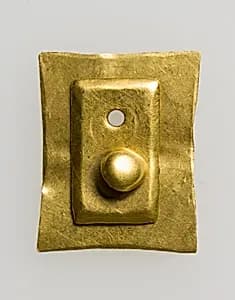
Gold Belt Mount with Rivet
Unknown Artist
700s
Medium
Gold
Dimensions
a and b: 1 × 13/16 × 3/16 in., 0.193 Troy Ounces (2.6 × 2.1 × 0.5 cm, 6g) a: 1 × 13/16 × 1/16 in., 0.096 Troy Ounces (2.6 × 2.1 × 0.1 cm, 3g) b: 3/4 × 1/2 × 3/16 in., 0.096 Troy Ounces (1.9 × 1.2 × 0.5 cm, 3g)
Classification
Metalwork-Gold
Culture
Avar
Department
Medieval Art
Museum
Metropolitan Museum of Art, New York, NY
Credit
Gift of J. Pierpont Morgan, 1917
Accession Number
17.190.1694a, b
Rights
Public Domain
Art Historical Context
This delicate **Gold Belt Mount with Riv**, crafted by an unknown Avar artisan in the700s, showcases the exquisite metalwork of the Avar people—a nomadic confederation that flourished in Central and Eastern Europe the early Middle Ages. just 1 × 13/16 inches and weighing 0.2 Troy ounces, this tiny gold piece (divided into riveted parts a and b) was likely part of an elite warrior's or leader's belt, a common status symbol among steppe nomads. Avars drew on influences from Eurasian trade routes, amassing gold to create such finery amid their khaganate's peak power. These mounts, classified as Medieval metalwork, highlight the culture's wealth and craftsmanship before their decline in the 9th century. The riveting technique ensured durability for daily wear, blending functionality with luxury. Today, gifted to the Metropolitan Museum of Art by J. Pierpont Morgan in 1917, this artifact invites us to marvel at Avar ingenuity—tiny yet telling of a vibrant, mobile world where gold whispered of prestige.