
Gold Glass Medallion with Christ as a Miracle Worker
Unknown Artist
300–500
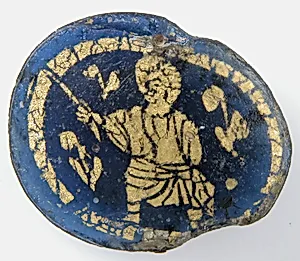
Medium
Glass, gold leaf
Dimensions
Overall: 13/16 x 1 x 3/16 in. (2.1 x 2.5 x 0.5 cm)
Classification
Glass-Gold glass
Culture
Roman or Byzantine
Department
Medieval Art
Museum
Metropolitan Museum of Art, New York, NY
Credit
Rogers Fund, 1918
Accession Number
18.145.8
Rights
Public Domain
Tags
Art Historical Context
This delicate gold glass medallion, from 300–500 CE, captures Christ as a miracle worker in a luminous portrait that exemplifies early Christian devotional art. Crafted by an unknown Roman or Byzantine artist, the circular object—measuring just 13/16 x 1 x 3/16 inches— intricate gold leaf fused between layers of glass, a technique that creates a radiant, ethereal glow evoking divine light. Such medallions were often set into grave markers, vessels, or personal jewelry, serving as intimate talismans of faith during Christianity's rise in the late Roman Empire. The gold glass method, popular in the 3rd to 5th centuries, involved engraving designs into a thin gold sheet, then sealing it between molten glass layers for durability and brilliance. This medallion's depiction of Christ underscores his role as healer and savior, a motif bridging pagan traditions with emerging Christian iconography. Housed in the Metropolitan Museum of Art's Medieval Art department (Rogers Fund, 1918), it reflects the cultural fusion of Rome and early Byzantium, where portable art like this spread religious devotion among everyday believers. Today, this tiny treasure offers a window into a pivotal era, highlighting how humble materials conveyed profound spiritual power. Visitors will appreciate its shimmering allure up close, a testament to ancient ingenuity.