
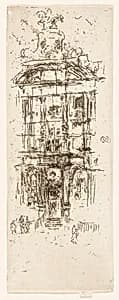
Gold House, Brussels
Medium
Etching with foul biting in black ink on off-white laid paper
Dimensions
Image, trimmed within platemark: 17.9 × 6.7 cm (7 1/16 × 2 11/16 in.); Sheet: 18.1 × 6.7 cm (7 3/16 × 2 11/16 in.)
Classification
etching
Department
Prints and Drawings
Museum
Art Institute of Chicago
Accession Number
20021
Rights
Public Domain
Art Historical Context
### Gold House, Brussels Step into the intimate world of James McNeillistler’s *Gold House, Brussels*1887), a masterful etching that captures the charm of Belgian urban life. Created in black ink on off-white laid, this small gem measures just 17.9 × 6.7 cm, trimmed close to the platemark a sense of immediacy. Whistler, the American-born artist renowned for his Aesthetic movement ideals—prioritizing "art for art's sake" through harmonious tones and subtle effects—produced this during a productive stay in Brussels. Here, he sketched everyday facades with poetic precision, transforming architecture into evocative atmospheres. The technique shines in its "foul biting," where unintended acid pits on the metal plate create textured, velvety depths, adding richness to the ink's bite. Far from a flaw, Whistler embraced these happy accidents, elevating etching beyond mere linework into tonal impressionism. This print exemplifies his printmaking genius, bridging 19th-century precision with modernist experimentation. Housed in the Art Institute of Chicago’s Prints and Drawings department, *Gold House* invites you to linger on its delicate contrasts—the gleam of golden walls against shadowed streets—reminding us how Whistler turned the ordinary into the sublime. A perfect study in subtlety! (198 words)
About the Artist
James McNeill Whistler · 1834–1903
James Abbott McNeill Whistler (1834-1903) was an American-born painter and printmaker who became a leading figure in the Aesthetic Movement and pioneer of Tonalism and Japonisme. He revolutionized art by championing "art for art's sake" and treating paintings as visual equivalents of musical compositions, titling works as "arrangements," "harmonies," and "nocturnes" to emphasize formal qualities o...