
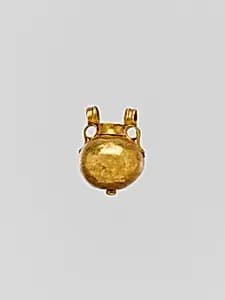
Gold pendant in the shape of a vase
Unknown Artist
late 6th–5th century BCE
Medium
Gold
Dimensions
Other: 1/2 in. (1.3 cm)
Classification
Gold and Silver
Culture & Period
Greek or Cypriot · Classical
Department
Greek and Roman Art
Museum
Metropolitan Museum of Art, New York, NY
Credit
The Cesnola Collection, Purchased by subscription, 1874–76
Accession Number
74.51.3633
Rights
Public Domain
Art Historical Context
This delicate gold pendant, shaped like a vase and crafted by an unknown artist the late 6th to 5th century BCE captures the elegance of Classical Greek or Cypriot artistry Measuring just 1/2 inch (1.3 cm), exemplifies the exquisite miniaturization prized in ancient jewelry, likely worn as a necklace ornament by elites who valued portability and prestige. Gold's rarity and luster made it a symbol of wealth and divine favor in the Mediterranean world, where Cypriot and Greek workshops excelled in sheet-gold techniques like hammering and soldering to form intricate shapes. The vase motif echoes everyday pottery vessels—ubiquitous in symposia and households—transforming a utilitarian object into personal adornment, perhaps with amuletic connotations for protection or prosperity. Part of the Metropolitan Museum of Art's Cesnola Collection, acquired by subscription in 1874–76, this pendant highlights Cyprus's role as a cultural crossroads between Greece, the Near East, and Egypt, preserving a snapshot of ancient luxury craftsmanship for modern admirers.