
Gold sheet appliques
Unknown Artist
1st half of the 5th century CE
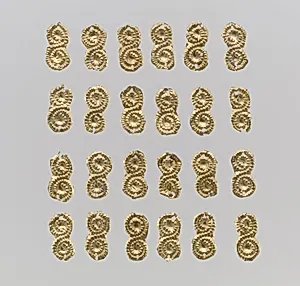
Medium
Gold
Dimensions
(Type A): 9/16 × 3/8 × 1/16 in. (1.4 × 1 × 0.2 cm) (Type B): 7/16 × 1/4 × 1/16 in. (1.1 × 0.6 × 0.2 cm)
Classification
Gold and Silver
Culture & Period
East Germanic or nomadic (?) · Migration
Department
Greek and Roman Art
Museum
Metropolitan Museum of Art, New York, NY
Credit
Purchase, 1898
Accession Number
98.11.71
Rights
Public Domain
Art Historical Context
These delicate gold sheet appliqués, crafted in the first half of the 5th century CE, hail from the turbulent Migration Period—a time when East Germanic tribes or nomadic peoples roamed Europe amid the Roman Empire's decline. Measuring just a few centimeters across (Type A: 1.4 × 1 × 0.2 cm; Type B: 1.1 × 0.6 × 0.2 cm), these tiny treasures were likely affixed to clothing, jewelry, or harnesses, shimmering as symbols of wealth and status among warrior elites. Hammered from thin gold sheets, the appliqués reflect the sophisticated metalworking of nomadic or Germanic craftsmen, who prized gold for its rarity and luster. Acquired by the Metropolitan Museum of Art in 1898, they offer a glimpse into a shadowy cultural crossroads, blending influences from steppe nomads and Germanic tribes like the Goths. Their presence in the Greek and Roman Art department underscores how Migration-era artifacts bridge classical antiquity and the early Middle Ages. Though the artist remains unknown, these pieces evoke the artistry of a mobile world, where portable luxury items told stories of power and migration. Visitors, picture them glinting on a chieftain's cloak during epic journeys across ancient landscapes!