
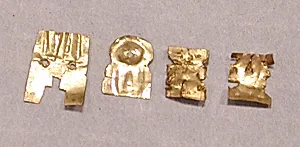
Gold Sheet Fragment
Unknown Artist
900–1470 CE
Medium
Gold (hammered)
Dimensions
H x W: 5/8 x 7/16 in. (1.6 x 1.1 cm)
Classification
Metal-Ornaments
Culture
Peruvian
Department
Arts of Africa, Oceania, and the Americas
Museum
Metropolitan Museum of Art, New York, NY
Credit
Gift of Mr. and Mrs. Nathan Cummings, 1964
Accession Number
64.228.558
Rights
Public Domain
Art Historical Context
This delicate *Gold Sheet Fragment*, crafted by an unknown Peruvian artist between 900 and 1470 CE, exemplifies the masterful metallurgy of pre-Columbian Andean cultures. Measuring just 5/8 x 7/16 inches (1.6 x 1.1 cm), this hammered gold piece—likely part of a larger ornament such as jewelry, headdress, or ceremonial object—was created through labor-intensive techniques. Artisans hammered thin gold sheets from natural nuggets, a process that demanded precision to achieve such fine, malleable forms without modern tools. In ancient Peru, during the Late Intermediate and Late Horizon periods, gold held profound spiritual significance, symbolizing the sun god Inti and divine power reserved for elites. Cultures like the Chimú and Inca revered it as a "sweat of the sun," using it in ornaments to convey status and connect the wearer to the cosmos. This fragment, a gift to the Metropolitan Museum of Art from Mr. and Mrs. Nathan Cummings in 1964, offers a glimpse into these sophisticated societies' artistry. Though small, it highlights Peru's metallurgical innovation, where gold was often alloyed or combined with other metals for durability. Visitors, marvel at how such tiny treasures once adorned warriors, priests, or rulers, whispering tales of a glittering pre-Columbian world.