
Gothic Armor
Unknown Artist
late 15th century; extensively restored and completed ca. 1926
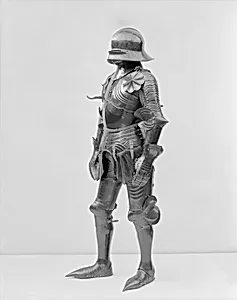
Medium
Steel, leather, copper alloy (latten), iron, brass
Dimensions
Wt. (without helmet) 45 lb. 4 oz. (20.53 kg); Wt. of mail sleeves 8 lb. (3629 g); 29.150.8n (leg defense); H. 21 in. (53.5 cm); W. 7 in. (17.8 cm); D. 9 in. (22.9 cm); Wt. 3lb. 12.1 oz. (1703.8 g); 29.150.8q (greave); H. 16 1/8 in. (41 cm); W. 4 13/16 in. (12.2 cm); D. 5 3/8 in. (13.7 cm); Wt. 2 lb. 1.3 oz. (944 g); 29.150.8r (mail sleeve): L. 28 5/16 in. (72.0 cm); W. 12 5/8 in. (32.0 cm); Diam. (outside) of main section links 7/32 in. (5.5 mm); Diam. (inside) of main section links 5/32 in. (4.7 mm); Diam. (outside) of cuff links 3/16 in. (4.4 mm); Diam. (inside) of cuff links 3/32 (2.5 mm); 29.150.8s (mail sleeve): L. 32 1/8 in. (81.5 cm); W. 15 in. (38.0 cm); Diam. (outside) of links 7/32 in. (5.9 mm); Diam. (inside) of links 5/32 (3.7 mm)
Classification
Armor for Man
Culture
German and Italian
Department
Arms and Armor
Museum
Metropolitan Museum of Art, New York, NY
Credit
Bashford Dean Memorial Collection, Bequest of Bashford Dean, 1928
Accession Number
29.150.8b–s
Rights
Public Domain
Art Historical Context
This stunning Gothic Armor, originating from Germany and Italy in the late 15th century, exemplifies the pinnacle of medieval plate armor craftsmanship during the late Gothic period. Designed for a man, it reflects the era's military innovations, when full-body protection evolved to counter advancing firearms and melee weapons. The suit's angular, fluted design—evoking Gothic architecture—offered both mobility and deflection of blows, weighing a formidable 45 pounds without its helmet, yet allowing a knight to mount a horse or wield a sword effectively. Crafted primarily from steel, with leather, copper alloy (latten), iron, and brass accents, the armor features intricate components like mail sleeves (one 28 inches long, the other 32 inches, with precisely woven links measuring 5-7 mm in diameter) and leg defenses such as greaves and sabatons. These details highlight the metallurgical expertise of German and Italian armories, where riveting, shaping, and butting created flexible yet impenetrable defenses. The mail's varying link sizes ensured durability at cuffs and joints. Extensively restored and completed around 1926, this composite piece entered the Metropolitan Museum of Art via the Bashford Dean Memorial Collection in 1928. Today, it invites visitors to ponder the human ingenuity behind chivalric warfare, blending historical combat utility with timeless sculptural beauty.