
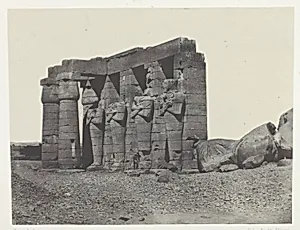
Gournah, Pérystyle du Tombeau d'Osymandias (Ramesseum Occidental); Thèbes, plate 59 from the album "Egypte, Nubie, Palestine et Syrie" (1852)
1849/51, printed 1852
Medium
Salted paper print
Dimensions
Image/paper: 16.9 × 22.1 cm (6 11/16 × 8 3/4 in.); Album page: 29.9 × 42.8 cm (11 13/16 × 16 7/8 in.)
Classification
salted paper print
Department
Photography and Media
Museum
Art Institute of Chicago
Accession Number
144273
Rights
Public Domain
Art Historical Context
Step into the sun-baked grandeur of ancient Egypt with Maxime Du Camp's *Gournah, Pérystyle du Tombeau d'Osymandias (Ramesseum Occidental); Thèbes*, plate 59 from his landmark 1852 album *Egypte, Nubie, Palestine et*. Captured during Du Camp's 1849–51 expedition alongside writer Gustave Flaubert, this salted paper print (16.9 × 22.1 cm)izes the perystyle colonnaded courtyard—of the Ramesseum, the mortuary temple of Pharaoh Ramesses II (known to the Greeks as Osymandias) in Western Thebes. The image reveals towering, weathered columns etched with hieroglyphs, evoking the pharaoh's monumental legacy amid the Nile Valley's timeless ruins. As one of the earliest photographers to document Egypt's antiquities, Du Camp harnessed the salted paper process—a pioneering technique from William Henry Fox Talbot's calotype era. Paper negatives were salted with sodium chloride, sensitized with silver nitrate, and contact-printed under sunlight, yielding soft, tonal images rich in detail yet subtly textured by the medium's inherent grain. Printed in 1852, this work bridged Romantic Orientalism and scientific precision, offering Europeans unprecedented, unfiltered views of pharaonic splendor that surpassed hand-drawn illustrations in accuracy. Housed in the Art Institute of Chicago's Photography and Media Department, this print underscores photography's role in 19th-century archaeology, fueling Egyptomania and preserving sites vulnerable to time and tourism. A window to lost empires, it invites you to ponder Ramesses II's hubris amid the quiet majesty of stone.
About the Artist
Maxime Du Camp · 1822–present
Maxime Du Camp (1822–1894) was a pioneering French photographer and writer whose adventurous spirit and technical innovation bridged literature and visual art during the mid-19th century. Born in Paris on February 8, 1822, to a prosperous family—his father a successful surgeon—Du Camp received a solid bourgeois education at the Collège Bourbon (now Lycée Condorcet), where he cultivated interests i...