
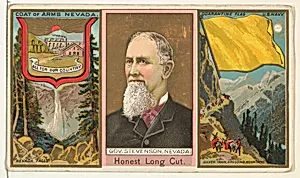
Governor Stevenson, Nevada, from "Governors, Arms, Etc." series (N133-1), issued by Duke Sons & Co.
ca. 1888
Medium
Commercial color lithograph
Dimensions
Sheet: 2 9/16 × 4 5/16 in. (6.5 × 11 cm)
Classification
Prints|Ephemera
Department
Drawings and Prints
Museum
Metropolitan Museum of Art, New York, NY
Credit
The Jefferson R. Burdick Collection, Gift of Jefferson R. Burdick
Accession Number
63.350.207.133.47
Rights
Public Domain
Tags
Art Historical Context
Step into the vibrant world of 19th-century American ephemera with *Governor Stevenson, Nevada*, commercial color lithograph from the "Governors, Arms, Etc." (N133-1), issued around 1888 by W. Duke, Sons & Co This petite card (just 2 9/16 × 4 5/16 inches) features a portrait of Nevada's Governor Thomas Stevenson alongside state symbols like the coat of arms and flags, the patriotic fervor of the Gilded Age Produced by the prominent Durham, North Carolina tobacco firm, it reflects how businesses leveraged colorful imagery to promote their products. These trade cards were tucked into cigarette packages as collectibles, sparking a nationwide hobby among Americans eager for affordable souvenirs. Duke's series highlighted U.S. governors and heraldry, blending civic pride with commerce during a time when states like Nevada—admitted to the Union in 1864—symbolized westward expansion and silver-mining booms. Stevenson's tenure (1887–1890) aligned perfectly with this era of rapid growth. Crafted via chromolithography, the technique allowed vivid, mass-produced colors on paper, democratizing art for everyday collectors. Now part of the Metropolitan Museum of Art's Jefferson R. Burdick Collection, this piece underscores ephemera's cultural role: a snapshot of politics, patriotism, and consumer culture that paved the way for modern trading cards.
About the Artist
W. Duke, Sons & Co. · 1870–1920
**W. Duke, Sons & Co.: Pioneers of Chromolithographic Trade Card Art** W. Duke, Sons & Co., an American tobacco manufacturer, emerged from the entrepreneurial vision of Washington Duke (1820–1905) and his sons in Durham, North Carolina. After the Civil War, Washington abandoned farming in 1874 to join his eldest son, Brodie L. Duke, in the burgeoning tobacco trade, establishing a factory that for...