
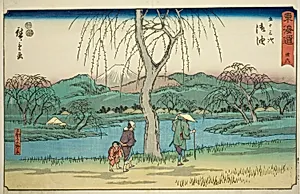
Goyu: Motono Plain along the Old Road (Kokaido Motonogahara)—No. 36, from the series "Fifty-three Stations of the Tokaido (Tokaido gojusan tsugi)," also known as the Reisho Tokaido
c. 1847/52
Medium
Color woodblock print; oban
Dimensions
23.8 × 34.9 cm (9 5/16 × 13 3/4 in.)
Classification
woodblock print
Department
Arts of Asia
Museum
Art Institute of Chicago
Accession Number
25844
Rights
Public Domain
Art Historical Context
Welcome to the Art Institute of Chicago's Arts of Asia collection, wheretagawa Hiroshige *Goyu: Motono along the Old Road (okaido Motonog)*—No. 36 from the renowned series *Fifty-three Stations of the Tōkaidō* (c. 1847/52)—captures the serene beauty of Japan's Edo-period travel culture. Hiroshige, a master of the ukiyo-e woodblock print tradition, immortalized the 53 post stations along the vital Tōkaidō highway connecting Edo (modern Tokyo) to Kyoto. This oban-sized color woodblock print (23.8 × 34.9 cm) depicts the expansive Motono Plain near Goyu station, evoking the journey's quiet expanses and everyday rhythms. Hiroshige's genius lies in his atmospheric landscapes, using subtle gradations of color achieved through meticulous woodblock printing—a collaborative craft where carvers, printers, and publishers layered inks from multiple blocks for vibrant, nuanced hues. Known as the "Reisho Tōkaidō" for its elegant calligraphy, this series edition highlights Hiroshige's poetic eye for nature's moods, blending travelers, fields, and distant mountains into harmonious compositions that elevated printmaking to high art. These affordable prints fueled Japan's print boom, inspiring pilgrims and merchants while later influencing Western artists like Van Gogh through Japonisme. Stroll virtually through Hiroshige's road and feel the pull of ancient wanderlust!
About the Artist
Utagawa Hiroshige · 1826–1869
Utagawa Hiroshige (1797–1858), born Andō Tokutarō, was the last great master of Japanese ukiyo-e woodblock printmaking and one of the most influential landscape artists in history. Born in Edo (modern Tokyo) into a low-ranking samurai family serving as fire wardens, Hiroshige transformed landscape printmaking into a poetic meditation on nature, weather, and everyday life. His revolutionary approac...