
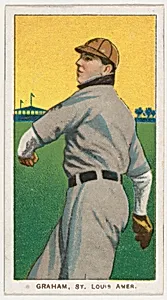
Graham, St. Louis, American League, from the White Border series (T206) for the American Tobacco Company
1909–11
Medium
Commercial lithograph
Dimensions
Sheet: 2 5/8 x 1 7/16 in. (6.7 x 3.7 cm)
Classification
Prints|Ephemera
Department
Drawings and Prints
Museum
Metropolitan Museum of Art, New York, NY
Credit
The Jefferson R. Burdick Collection, Gift of Jefferson R. Burdick
Accession Number
63.350.246.206.156
Rights
Public Domain
Tags
Art Historical Context
Step into the early days of America's pastime with this charming commercial lithograph from the renowned T206 White Border series produced by the American Tobacco between 1909 and 1911. Titled *Graham, St. Louis, American League*, it features baseball player from the St. Louis team, captured in a classic portrait style typical of these pocket-sized cards (just 2 5/8 x 1 7/16 inches). Inserted into cigarette packs as promotional giveaways, these ephemer prints turned everyday tobacco products into collectibles, fueling a burgeoning hobby among fans. Lithography allowed for vibrant, mass-produced color images that brought athletes to life with sharp details and clean white borders, making the T206 set one of the most celebrated in baseball card history. This card exemplifies commercial art's role in popular culture, blending advertising savvy with sports hero worship during baseball's golden age as a national obsession. Today, housed in the Metropolitan Museum of Art's Drawings and Prints department as part of The Jefferson R. Burdick Collection, it reminds us how everyday objects captured the spirit of early 20th-century America—where sports, commerce, and collecting intertwined. A tiny window into a bigger game!
About the Artist
American Tobacco Company · 1826–1909
**American Tobacco Company (1890–1911)** Founded on January 31, 1890, in Durham, North Carolina, by James Buchanan Duke, the American Tobacco Company emerged from the consolidation of five major U.S. tobacco manufacturers: W. Duke & Sons, Allen & Ginter, Goodwin & Company, W.S. Kimball & Co., and Kinney Brothers. Under Duke's aggressive leadership, it rapidly achieved monopoly status, controlling...