
Grandfather's Clock
1936
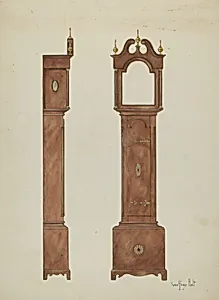
Medium
watercolor, colored pencil, gouache, pen and ink, and graphite on paper
Dimensions
overall: 35.5 x 26.2 cm (14 x 10 5/16 in.) Original IAD Object: 7'6"high
Classification
Index of American Design
Department
CG-W
Museum
National Gallery of Art, Washington, D.C.
Credit
Index of American Design
Accession Number
1943.8.4826
Rights
Public Domain
Art Historical Context
In the heart of the Great Depression, the Index of American Design (I)—a Federal Art Project under the Progress Administration—commissioned artists like Geoffrey Holt to create meticulous renderings of everyday American objects, preserving the rich material culture. *Grandfather's Clock* (1936), Holt's vibrant mixed-media depiction on paper, captures a towering 7'6" tall timepiece, rendered at 35.5 x 26.2 cm. This work exemplifies the IAD mission to celebrate folk art and craftsmanship, highlighting how such heirloom clocks anchored life in colonial and early American homes. Holt masterfully blends watercolor, colored pencil, gouache, pen and ink, and graphite to achieve hyper-realistic detail, from the clock's ornate hood and pendulum swing to its warm wood tones and brass accents. These techniques allowed for precise color gradients and fine lines, making the rendering both a faithful document and an artistic tribute. Displayed in the National Gallery of Art's CG-W department, it underscores the cultural significance of grandfather clocks as symbols of endurance and tradition amid economic hardship. Today, this piece invites visitors to appreciate the ingenuity of American design, bridging past craftsmanship with modern eyes.
About the Artist
Geoffrey Holt · 1855–present
Geoffrey Holt was born in England on August 18, 1882, and received his artistic training in London and Paris before eventually making his career in the United States. After arriving in America, he lived in Minneapolis, where he worked as an interior designer for the John S. Bradstreet Company—an experience that developed his sensitivity to space, surface, and decorative harmony. By around 1920 he ...