
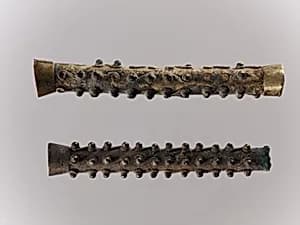
Granulated Tube Pendant
Unknown Artist
ca. 1479–1425 B.C.
Medium
Gold
Dimensions
L. 3.8 × W. 0.8 cm (1 1/2 × 5/16 in.)
Classification
Pendant, granulated tube
Period
New Kingdom
Department
Egyptian Art
Museum
Metropolitan Museum of Art, New York, NY
Credit
Purchase, Lila Acheson Wallace Gift, 2002
Accession Number
2002.158.4
Rights
Public Domain
Art Historical Context
This delicate **Granulated Tube Pendant**, crafted from gleaming gold around 1479–1425 B.C., hails from Egypt's New Kingdom, specifically Dynasty 18—a golden age of pharaonic power and artistic splendor under rulers like Hatshepsut Thutmose III. just 3.8 cm long and 0.8 cm wide, this tiny tube-shaped jewel exemplifies the era's mastery of luxury goods, likely worn as part of elite jewelry or as an amulet for protection and status. The pendant's standout feature is its **granulation technique**, a virtuoso method where thousands of minuscule gold spheres (often less than a millimeter in diameter) are precisely fused onto the surface without soldering, creating a textured, shimmering effect. This labor-intensive process, perfected by Egyptian goldsmiths, highlights their advanced metallurgical skills and the abundance of Nubian gold that fueled New Kingdom workshops. Such adornments were symbols of wealth and divine favor, bridging the earthly and eternal realms. Acquired by The Metropolitan Museum of Art in 2002 through the Lila Acheson Wallace Gift, this artifact invites us to marvel at ancient ingenuity—proof that even millennia ago, artisans crafted beauty on a miniature scale that still captivates today.