
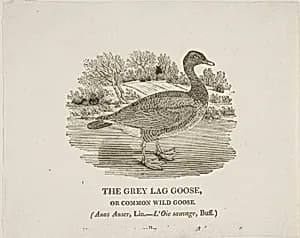
Grey Lag Goose
n.d.
Medium
Woodcut on ivory wove paper
Dimensions
Image/sheet: 11 × 13.7 cm (4 3/8 × 5 7/16 in.)
Classification
relief etching
Department
Prints and Drawings
Museum
Art Institute of Chicago
Accession Number
20138
Rights
Public Domain
Art Historical Context
Thomas Bewick's *Grey Lag Goose*, a woodcut on ivory w paper, captures the wild ancestor of the domestic goose with remarkable precision. Created by the renowned English engraver (1753–1828), this undated print measures a modest 11 × 13.7 cm, showcasing Bewick's signature style from his pioneering natural history illustrations. Housed in the Art Institute of Chicago's Prints Drawings Department and classified as a relief etching, it exemplifies the artist's ability to blend scientific observation with artistic finesse during the late 18th and early 19th centuries. Bewick revolutionized wood engraving—a relief printing technique where the artist incises fine lines into the end-grain of boxwood blocks, allowing for intricate details rivaling copperplate engravings. Unlike broader woodcuts, his method produced lifelike textures, from the goose's soft feathers to its alert posture, making prints affordable and widely accessible. This innovation democratized high-quality nature imagery, influencing book illustration and ornithological art. As part of Bewick's celebrated *History of British Birds* series, *Grey Lag Goose* highlights his passion for Britain's wildlife, blending education with subtle humor in his vignettes. Visitors will appreciate how this small gem reflects the Romantic era's reverence for nature, inviting a closer look at the everyday wonders of the avian world.
About the Artist
Thomas Bewick · 1753–1828
Thomas Bewick (c. 11 August 1753–8 November 1828) was born at Cherryburn in Mickley, Northumberland, the eldest of eight children to tenant farmers John and Jane Bewick. From a young age, he displayed a natural talent for drawing animals and birds observed in the local countryside, without formal art lessons. At age 14 in 1767, he was apprenticed to metal engraver Ralph Beilby in Newcastle upon Ty...