
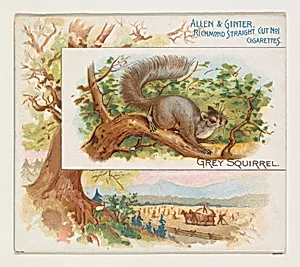
Grey Squirrel, from Quadrupeds series (N41) for Allen & Ginter Cigarettes
Medium
Commercial color lithograph
Dimensions
Sheet: 2 7/8 x 3 1/4 in. (7.3 x 8.3 cm)
Classification
Prints|Ephemera
Department
Drawings and Prints
Museum
Metropolitan Museum of Art, New York, NY
Credit
The Jefferson R. Burdick Collection, Gift of Jefferson R. Burdick
Accession Number
63.350.202.41.17
Rights
Public Domain
Tags
Art Historical Context
Behold the charming *Grey Squirrel* from Allen & Ginter's Quadeds series (N41 a delightful 1890 commercial color lithograph produced for cigarette packs. This petite print (just 2 7/8 x 3 1/4 inches) captures the alert, bushy-tailed rodent in vivid detail, exemplifying the era's fascination with wildlife illustration. Tobacco companies like Allen & Ginter revolutionized marketing by inserting collectible cards into their products, sparking a collecting craze among Americans and turning everyday ephemera into treasures. Crafted via chromolithography—a pioneering color printing technique that layered inks for vibrant, mass-produced hues—the card showcases the skill of lithographers Lindner, Eddy & Claus. Issued during the Gilded Age, when advertising boomed, these cards educated and entertained, blending natural history with commerce. Today, housed in the Metropolitan Museum of Art's Jefferson R. Burdick Collection, it highlights ephemera's artistic merit and the evolution of commercial art. Fun fact: Part of a series featuring quadrupeds, this squirrel card reflects 19th-century nostalgia for nature amid rapid industrialization, inviting collectors to assemble a menagerie one puff at a time. A tiny window into Victorian-era pop culture!
About the Artist
Allen & Ginter|Lindner, Eddy & Claus
Allen & Ginter, the pioneering American tobacco firm based in Richmond, Virginia, emerged around 1880 from the partnership of John F. Allen and Lewis Ginter, evolving from Allen's earlier John F. Allen & Company. Allen retired in 1882, succeeded by John Pope, yet the brand endured under Ginter's leadership, employing over 1,100 workers—mostly women—for hand-rolled cigarettes by 1886. Ginter, a Dut...