
Groep Roma
1825 - 1882
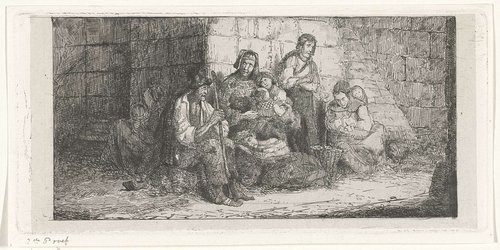
Medium
etching
Dimensions
105; 224
Rights
Public Domain
About this artwork
ets; proefdruk
Art Historical Context
**Groep Roma** is a delicate etching by Dutch artist Jacobus Ludovicus Cornet (1825–1882), during the mid-19th century. just 105 mm high by 224 mm wide, intimate print captures a "Groep Roma"—a group of Roma people, the nomadic Romani community often romanticized or stereotyped in European art of the era. Cornet, known for his precise line work in etchings, reflects the 19th-century fascination with genre scenes depicting everyday life, folklore, and marginalized travelers. Etching, the artwork's medium ("ets" in Dutch), involves incising lines into a metal plate with acid, creating fine, expressive details ideal for textures like clothing folds or facial expressions. This piece is a "proefdruk," or proof print—an early trial impression pulled from the plate before final refinements. Such proofs offer rare glimpses into an artist's process, preserving tentative lines and tonal experiments that might later be polished. In the context of 19th-century printmaking, **Groep Roma** highlights etching's role in democratizing art, allowing wider distribution of vivid social vignettes. It invites viewers to ponder the Roma's cultural vibrancy amid Europe's industrial shifts, blending technical mastery with human storytelling in a compact, evocative format.
About the Artist
Jacobus Ludovicus Cornet · 1815–1882
Jacobus Ludovicus Cornet (1815–1882) was a Dutch painter, draughtsman, and museum curator whose career bridged artistic practice and cultural preservation. Born in Leiden in 1815, Cornet devoted his life to documenting Dutch history and culture through his paintings and drawings while simultaneously working to preserve the nation's artistic heritage as head of Leiden's Prentenkabinet (Prints Cabin...