
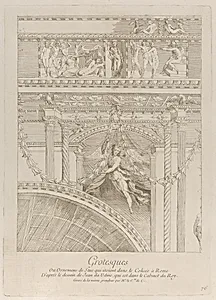
Grotesques: detail of the stucco reliefs decorating the Colosseum in Rome, with a winged figure hovering between two pairs of columns
Medium
Etching
Dimensions
Plate: 13 3/16 × 9 7/16 in. (33.5 × 24 cm) Sheet: 20 13/16 × 15 5/16 in. (52.9 × 38.9 cm)
Classification
Prints
Department
Drawings and Prints
Museum
Metropolitan Museum of Art, New York, NY
Credit
Gift of Harry G. Friedman, 1960
Accession Number
60.708(11)
Rights
Public Domain
Art Historical Context
This etching, created around 1729, captures a delicate detail from the ancient stucco reliefs that once adorned the Colosseum in Rome. It features a graceful winged figure suspended between paired columns, rendered in the playful, intricate style known as grotesques—ornamental designs drawn from Roman antiquity that blend human, animal, and vegetal forms. The print highlights the refined craftsmanship of the original reliefs, which survived from the Flavian era and inspired generations of artists fascinated by classical decoration. Giovanni da Udine, a sixteenth-century master celebrated for reviving grotesque motifs in collaboration with Raphael, likely provided the foundational study, while the Comte de Caylus, an eighteenth-century antiquarian and printmaker, translated it into this etching. Working in a period of renewed interest in Rome’s archaeological heritage, Caylus helped document and circulate such details through prints, making remote ancient works accessible to scholars and collectors across Europe. As a work on paper rather than the original stucco, the etching serves as both record and interpretation, preserving fragile architectural ornament through the precise lines of the medium. Housed today in the Metropolitan Museum of Art, it invites viewers to appreciate how Renaissance and Enlightenment artists bridged centuries by studying and sharing Rome’s enduring artistic legacy.