
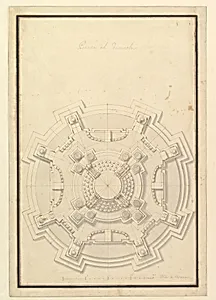
Ground Plan of a Catafalque for Francis Lewis of Newburg, Archshop of Mainz (died Breslau 1732)
ca. 1732
Medium
Pen, brown ink and gray wash over pencil
Dimensions
19-3/8 x 13-3/16 in. (49.2 x 33.5 cm)
Classification
Drawings
Department
Drawings and Prints
Museum
Metropolitan Museum of Art, New York, NY
Credit
Purchase, Bequest of Joseph H. Durkee, by exchange, 1972
Accession Number
1972.713.30
Rights
Public Domain
Tags
Art Historical Context
This intricate drawing by Giuseppe Galli Bibiena a master of the Bibiena family’s Baroque scenographic tradition, presents the ground plan for a grand catafalque honoring Francis Lewis of Newburg, Archbishop Mainz, who died inlau in 1732. Created around that year, it captures the opulent temporary architecture used for ecclesiastical funerals in the Holy Roman Empire, where such structures elevated the deceased’s status through dramatic scale and symbolism. As Elector-Archbishop, Lewis wielded significant political and religious influence, making his memorial a display of Counter-Reformation splendor. Bibiena, renowned for illusionistic stage designs that blurred architecture and theater, employs pen in brown ink over pencil for precise lines, enhanced by gray wash to evoke depth and materiality. This medium, common in 18th-century architectural drafts, allowed designers to convey complex spatial plans on a modest sheet (19-3/8 x 13-3/16 inches), guiding builders in erecting ephemeral yet majestic edifices. The work exemplifies Baroque fusion of engineering and spectacle, now preserved in The Metropolitan Museum of Art’s Drawings and Prints collection. Today, it offers a window into the era’s ritual pomp, reminding us how drawings like this orchestrated public grief and power.
About the Artist
Giuseppe Galli Bibiena · 1696–1757
Giuseppe Galli Bibiena was born on January 5, 1696, in Parma, into what would become the most celebrated dynasty of theatrical designers in Baroque Europe. He was the second son of Ferdinando Galli Bibiena, who was himself a transformative figure in stage design and the originator of the family's defining innovation: the scena per angolo, or "scene viewed at an angle." This technique replaced the ...