
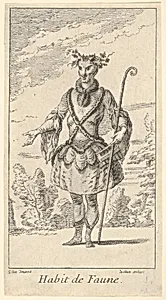
Habit de Faune: a faun wearing a tonnelet with a flute attached, a cane in his right hand and vines around his horns, from 'New designs for costumes' (Nouveaux desseins d'habillements à l'usage des balets operas et comedies)
ca. 1721
Medium
Etching
Dimensions
image: 5 7/8 x 3 1/8 in. (14.9 x 8 cm)
Classification
Prints
Department
Drawings and Prints
Museum
Metropolitan Museum of Art, New York, NY
Credit
Bequest of Phyllis Massar, 2011
Accession Number
2012.136.377.4
Rights
Public Domain
Tags
Art Historical Context
Step into the whimsical world of 18th French theater with *Habit de Faune* from Gillot's *Nouveaux desseins dhabillements à l'usage des balets,éras et comédies* (New Designs for Costumes for Ballets,as, and Comedies), etched around 1721 by François Joullain. enchanting print captures a lively faun—drawn from classical mythology as a playful, horned woodland spirit—adorned in a tonnelet (a short, pleated skirt), with a flute tucked into his belt, a cane in his right hand, and vines twining his horns. At just 5 7/8 x 3 1/8 inches, it's a precise blueprint for performers in the opulent ballets and operas of the Regency era, following Louis XIV's death, when Paris theaters buzzed with spectacle and fantasy. Claude Gillot, a pioneering painter and designer who mentored Antoine Watteau, infused his works with theatrical flair and early Rococo lightness, blending grotesque and elegant motifs. Joullain's etching technique—scratching acid-resistant lines into a metal plate for fine, reproducible details—made these designs accessible to costumers across Europe, revolutionizing stage fashion. Etchings like this democratized high art, turning mythological revelry into wearable drama. This piece, now in the Metropolitan Museum of Art's Drawings and Prints collection (Bequest of Phyllis Massar, 2011), highlights the era's cultural obsession with antiquity's joyful spirits, evoking the dances of satyrs and nymphs that enchanted audiences amid France's artistic golden age. A delightful glimpse into how myth met the footlights!
About the Artist
Claude Gillot|François Joullain · 1673–1722
Artist known for his elegant designs done in the Rococo manner of Audran; also for his predilection for scenes from the 'comedia dell'arte.' Few paintings survive; his work is known mainly through drawings and etchings. Comment on works: Genre; History