
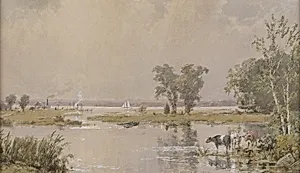
Hackensack Meadows
Medium
Watercolor, gouache, and graphite on off-white wove paper
Dimensions
12 x 20 1/2 in. (30.5 x 52.1 cm)
Classification
Watercolor
Culture
American
Department
The American Wing
Museum
Metropolitan Museum of Art, New York, NY
Credit
Gift of Mrs. John C. Newington, 1992
Accession Number
1992.97
Rights
Public Domain
Tags
About this artwork
This Watercolor, gouache, and graphite on off-white wove paper by Jasper Francis Cropsey from 1890 exemplifies historical artistic production through its materials, techniques, and aesthetic approach. Created within specific cultural and historical contexts, works like this reflect both individual artistic vision and broader patterns of workshop practice, patron expectations, and prevailing aesthetic theories. The medium of Watercolor, gouache, and graphite on off-white wove paper required speci...
Art Historical Context
Jasper Francis Cropsey's *Hackensack Meadows*1890) captures the serene beauty of New Jersey's expansive wetlands, a landscape dotted with meandering rivers and grazing cows As a leading figure in the Hudson River School, Cropsey was renowned for his luminous depictions of the American countryside, emphasizing nature's grandeur and the changing seasons. This late-career work reflects his lifelong passion for pastoral scenes, evoking a sense of tranquility amid the meadows' vast skies and watery expanses. Rendered in watercolor, gouache, and graphite on off-white wove paper (12 x 20 1/2 in.), the piece showcases Cropsey's mastery of mixed media. Watercolor provides ethereal transparency for atmospheric effects, while gouache adds rich opacity to foliage and earth tones, and graphite offers precise underdrawing. These techniques, honed through decades of training, highlight the Hudson River School's blend of Romantic idealism and meticulous observation, making watercolors prized for their portability and vividness in the 19th century. Housed in The Metropolitan Museum of Art's American Wing, this gift from Mrs. John C. Newington in 1992 preserves a snapshot of pre-industrial America. It underscores cultural values of the Gilded Age—admiration for untamed wilderness amid rapid urbanization—and invites viewers to ponder humanity's harmony with nature.
About the Artist
Jasper Francis Cropsey · 1823–1900
Jasper Francis Cropsey (1823–1900) was an American landscape painter associated with the Hudson River School, the influential mid-nineteenth-century movement that celebrated the natural grandeur of the American continent in large, luminous canvases. Born on Staten Island, New York, Cropsey initially trained as an architect — a background that gave him a strong sense of spatial structure and formal...