
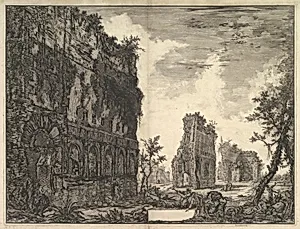
Hadrian's Villa: The Piazza d'Oro (Piazza of Gold) (Veduta degli Avanzi della Circonferenza delle antiche Fabbriche di una delle Piazze della Villa Adriana oggidi chiamata Piazza d'oro)
ca. 1776
Medium
etching
Classification
Prints
Department
Drawings and Prints
Museum
Metropolitan Museum of Art, New York, NY
Credit
Purchase, Anne and Carl Stern Gift, 1960
Accession Number
60.669.1
Rights
Public Domain
Tags
Art Historical Context
Step into the sunlit ruins of Emperor Hadrian's opulent villa at Tivoli through Giovanni Battista Piranesi's masterful etching, *Hadrian's Villa: The Piazza d'Oro (Piazza of Gold)*, around 1776. This veduta—or detailed view—captures the crumbling arches and walls of the Piazza d'Oro, a lavish courtyard within the vast 2nd-century AD complex built by the Roman emperor as his retirement retreat. Piranesi, a Venetian-born artist famed for his dramatic depictions of ancient Rome, transports viewers to this "Golden Square," evoking the grandeur of imperial Rome amid its poignant decay. Piranesi's etching technique shines here, with intricate cross-hatching and rich tonal contrasts that add depth, shadow, and a sense of sublime mystery to the ruins. Part of his extensive series on Hadrian's Villa, the print reflects the 18th-century Grand Tour fascination with classical antiquity, blending precise architectural accuracy with imaginative flair. As a print from the Metropolitan Museum of Art's collection, it exemplifies how etchings democratized access to these wonders, inspiring generations of architects and artists. Today, this work reminds us of Hadrian's eclectic tastes—drawing from Greek, Egyptian, and Roman designs—and Piranesi's genius in romanticizing history, turning stone fragments into timeless poetry.
About the Artist
Giovanni Battista Piranesi · 1720–1778
Giovanni Battista Piranesi (1720–1778) was an Italian printmaker, architect, and antiquarian whose visionary etchings of Rome and imaginary prisons revolutionized architectural representation and profoundly influenced both Neoclassicism and Romanticism. Piranesi stands as one of the most important printmakers of the eighteenth century, fundamentally shaping European perceptions of ancient Rome an...