
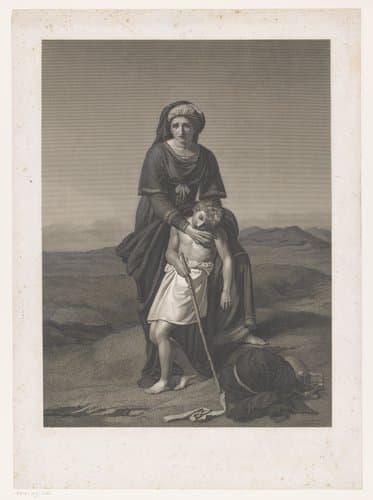
Hagar en Ishmael in de woestijn
1815 - 1862
Medium
steel engraving
Dimensions
396; 543
Rights
Public Domain
About this artwork
verzamelaarsmerk, verso, gestempeld: Lugt 2228
Art Historical Context
### Hagar and Ishmael in Desert Visitors to our gallery will encounter *Hagar en Ishmael de woestijn* (Hagar and Ishmael in the Desert a poignant steel engraving by Erin Corr dated between 1815 1862. This work draws from the biblical narrative in Genesis, depicting the exiled Egyptian servant Hagar and her son Ishmael wandering the wilderness after being cast out by Abraham and Sarah. Such scenes were popular in 19th-century European art, symbolizing themes of divine providence, maternal suffering, and survival against despair—resonating with Romantic interests in human emotion and spirituality. Crafted as a steel engraving, the piece measures an impressive 543 mm high by 396 mm wide, showcasing the medium's advantages over earlier copperplate techniques. Introduced in the early 1800s, steel allowed for finer lines, greater durability, and larger edition sizes, making detailed reproductive prints accessible to a wider audience. Corr's rendition likely captures the dramatic desolation of the desert with intricate shading and textures, evoking empathy for the figures' plight. On the verso, a collector's mark stamped Lugt 2228 attests to its esteemed provenance, linking it to a distinguished European collection. This engraving not only highlights Corr's skill in narrative illustration but also reflects the era's blend of religious storytelling and technical innovation in printmaking. A timeless reminder of faith amid adversity! (198 words)
About the Artist
Erin Corr · 1803–1862
Erin Corr (1803–1862) was an Irish engraver of exceptional skill and dedication, born in Brussels of Irish descent on an unknown date in 1803 and dying on August 10, 1862. His career exemplified the internationalism of 19th-century European art, as he trained in Belgium and France before establishing himself as a professor at the Antwerp Academy, where he influenced the next generation of engraver...