
Hagi no Tamagawa
Medium
Woodblock print; ink and color on paper
Dimensions
10 3/4 x 7 7/8 in. (27.3 x 20 cm)
Classification
Prints
Culture & Period
Japan · Edo period (1615–1868)
Department
Asian Art
Museum
Metropolitan Museum of Art, New York, NY
Credit
Harris Brisbane Dick Fund, 1946
Accession Number
JP3023
Rights
Public Domain
Tags
Art Historical Context
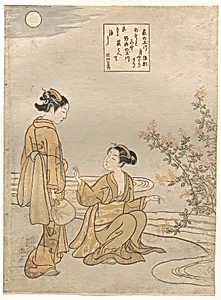
Suzuki Harunobu's *Hagi no Tam* is a captivating wood print from Japan's Edo period1615–1868), showcasing the artist's mastery of ukiyo, the "pictures of the floating world" that celebrated beauty and everyday elegance. Created with ink and vibrant colors on paper, this intimate 10 3/4 x 7 7/8 in. work exemplifies Harunobu's pioneering in full-color nishiki-e prints, introduced around 1765 which brought unprecedented depth and luminosity to the medium through precise woodblock layering. The scene evokes the poetic beauty of Hagi no Tamagawa, one of Japan's legendary Six Crystal Rivers (Tamagawa), famed in literature for its shimmering waters and surrounding bush clover (hagi) blooms. Graceful women—likely courtesans or beauties—interact serenely by the river amid lush plants, blending nature's tranquility with human refinement. This reflects Edo-era fascination with scenic bijin-ga (pictures of beautiful women), where such idyllic vignettes offered escapism amid urban life. Housed in the Metropolitan Museum of Art's Asian Art Department, acquired via the Harris Brisbane Dick Fund in 1946, the print highlights Harunobu's influence on later masters like Utamaro and Hiroshige, preserving a golden age of Japanese printmaking for modern admirers.
About the Artist
Suzuki Harunobu · 1725–1770
Suzuki Harunobu (c. 1725-1770) was a Japanese ukiyo-e artist who revolutionized woodblock printing by developing nishiki-e—full-color prints using multiple woodblocks—in 1765. Before Harunobu, Japanese prints were limited to two or three colors; his innovation unleashed the entire artist's palette, transforming ukiyo-e into the vibrant art form that would later captivate Western artists from Manet...