
Hakurai taizo no zu|View of the Large Imported Elephant
1863 (Bunkyo 3, 4th month)
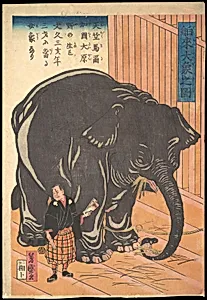
Medium
Woodblock print; ink and color on paper
Dimensions
Image: 14 3/4 × 10 3/16 in. (37.5 × 25.9 cm)
Classification
Prints
Culture & Period
Japan · Edo period (1615–1868)
Department
Asian Art
Museum
Metropolitan Museum of Art, New York, NY
Credit
Gift of Lincoln Kirstein, 1959
Accession Number
JP3284
Rights
Public Domain
Tags
Art Historical Context
In 1863, during the final years of Japan's Edo period (16151868), ukiyo-e artist Tag (Utagawa) Yoshimori captured a rare spectacle in his woodblock print *Hakurai taizo no zu (View of the Large Imported Elephant)*. Part of the celebrated Utagawa school, Yoshimori specialized in vibrant prints depicting contemporary life, news, and curiosities. This *nishiki-e* (brocade picture)—inked and hand-colored on paper—measures about 14¾ × 10¼ inches, showcasing the meticulous woodblock technique where multiple blocks created rich layers of color and fine detail. The artwork immortalizes the arrival of a massive imported elephant, an extraordinary event that drew crowds in isolationist Japan. Elephants were virtually unknown in the country, making this beast a symbol of exotic wonder and the encroaching influence of foreign trade amid growing Western contacts. Men gather around the animal, their expressions blending awe and amusement, reflecting public fascination with global novelties just before the Meiji Restoration upended traditional society. Housed in the Metropolitan Museum of Art's Asian Art Department (gift of Lincoln Kirstein, 1959), this print offers a vivid window into late Edo culture—where art swiftly documented life's thrills, blending everyday realism with theatrical flair. A delightful glimpse of history's surprises!
About the Artist
Taguchi (Utagawa) Yoshimori · 1830–1884
**Taguchi Yoshimori (Utagawa Yoshimori), 1830–1884** Born in 1830 as Taguchi Sakuzō, Utagawa Yoshimori emerged as a talented ukiyo-e print designer during Japan's turbulent late Edo period. Little is known of his early life, but he trained under the renowned Utagawa Kuniyoshi, a master of the Utagawa school whose dynamic compositions and innovative themes profoundly shaped Yoshimori's style. Adop...