
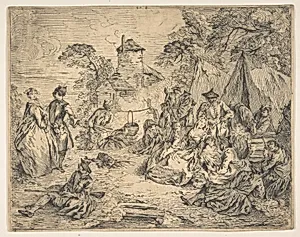
Halte des Troupes (Soldiers and Women in an Encampment)
18th century
Medium
Etching
Dimensions
sheet: 6 7/8 x 8 3/4 in. (17.5 x 22.2 cm)
Classification
Prints
Department
Drawings and Prints
Museum
Metropolitan Museum of Art, New York, NY
Credit
Harris Brisbane Dick Fund, 1936
Accession Number
36.62
Rights
Public Domain
Tags
About this artwork
The anonymous Italian 'Arch of Septimius Severus' engraving from Speculum Romanae Magnificentiae (16th century) documents Renaissance fascination with Roman antiquity. Published 1583 by Claudio Duchetti in Rome, this print belongs to Antonio Lafreri's innovative publishing project. Lafreri (1512-1577) published single page titled Speculum Romanae Magnificentiae (Mirror of Roman Magnificence) around 1575, encouraging collectors to compile albums of impressions. During sixteenth century, collector...
Art Historical Context
Jean-Baptiste Joseph Pater's *Halte des Troup (Soldiers and Women an Encampment)* an 18th-century, captures a lively moment of respite amid military life. Measuring 6 7/8 x 8 3/4 inches, this intimate print from the Metropolitan Museum of Art's and Prints department depicts soldiers pausing in a tented encampment, joined by women, evoking casual camaraderie of camp followers. Tags highlight elements like tents, men, women, and even castles, suggesting a picturesque backdrop blending rugged military settings with architectural grandeur. As a Rococo-era artist, Pater excelled in such genre scenes, rendering the etching's fine lines to convey texture in fabrics, dynamic figures, and atmospheric depth. Etching, a printmaking technique using acid to bite designs into metal plates, allowed for detailed, reproducible works that brought these vignettes to wider audiences. Acquired through the Harris Brisbane Dick Fund in 1936, it reflects the era's fascination with leisure amid war, offering a window into 18th-century French social dynamics. This print not only showcases Pater's technical finesse but also preserves a slice of everyday life during Europe's age of frequent conflicts, making Rome's distant ruins feel worlds away from these grounded, human encounters.