
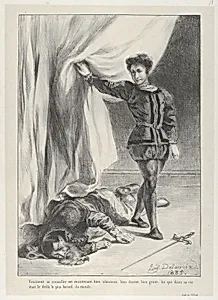
Hamlet and the Corpse of Polonius
Medium
Lithograph; second state of four
Dimensions
Image: 10 1/16 x 6 15/16 in. (25.5 x 17.7 cm) Sheet: 11 3/16 x 7 15/16 in. (28.4 x 20.1 cm)
Classification
Prints
Department
Drawings and Prints
Museum
Metropolitan Museum of Art, New York, NY
Credit
Rogers Fund, 1922
Accession Number
22.56.14
Rights
Public Domain
Tags
Art Historical Context
In Eugène Delacroix's dramatic lithograph *Hamlet and the Corpse Polonius* (1835), we witness a pivotal moment from William Shakespeare's tragedy *Hamlet*. The image captures Prince Hamlet in the heat of Act 3, Scene 4, after he has fatally stabbed Polonius, mistaking him for the king behind the arras. Delacroix, a master of French Romanticism, infuses the scene with intense emotion—Hamlet's wild-eyed remorse contrasts sharply with the lifeless form of the corpse, sword in hand, evoking the play's themes of madness, vengeance, and mortality. Created as part of Delacroix's acclaimed series of 13 lithographs illustrating *Hamlet*, this work exemplifies his innovative use of the medium. Lithography allowed the artist to achieve painterly effects with fluid lines and rich tonal contrasts, bridging drawing and printmaking. This is the second state of four, refined through progressive reworking to heighten drama and depth, showcasing Delacroix's technical mastery during the 1830s Romantic revival of Shakespearean themes on the Continent. Housed in the Metropolitan Museum of Art's Drawings and Prints department (Rogers Fund, 1922), this 10 x 7-inch print highlights 19th-century fascination with English literature and the power of visual storytelling. It remains a testament to how Delacroix's dynamic style brought Shakespeare's psychological intensity to life for a new audience.
About the Artist
Eugène Delacroix|William Shakespeare|Villain · 1798–1863
Eugène Delacroix (1798–1863) stands as the defining figure of French Romanticism and a pivotal bridge to modernism. Born in Charenton-Saint-Maurice near Paris, he came from distinguished lineage—his mother descended from the prestigious Oeben-Riesener furniture dynasty, while persistent speculation suggested the statesman Talleyrand may have been his biological father, a theory supported by physic...