
Hanau
Medium
Etching, secons state of two
Dimensions
Sheet: 2 3/8 × 3 11/16 in. (6 × 9.4 cm) cut on the platemark
Classification
Prints
Department
Drawings and Prints
Museum
Metropolitan Museum of Art, New York, NY
Credit
Gift of Carl J. Ulmann, 1924
Accession Number
24.57.90
Rights
Public Domain
Tags
Art Historical Context
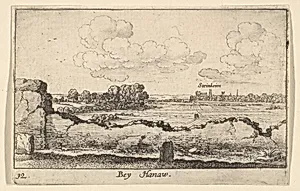
Step into the intimate world of 17th-century Europe with *Hanau*, a delicate etching in 1635 by Wenceslauslar and Abraham Hogenberg. This second state of two impressions, measuring just 2 3/8 × 3 11/16 inches, captures a poignant scene of ruins intertwined with trees—evoking nature's quiet reclaiming of war-torn landscapes. Hollar, a masterful Bohemian etcher renowned for his precise topographic views, collaborated here with Hogenberg, their skills in printmaking to produce a compact yet evocative image, now housed in The Metropolitan Museum of Art's Drawings and Prints department as a gift from Carl J. Ulmann in 1924. Dated to the heart of the Thirty Years' War (1618–1648), the print likely reflects the devastation around Hanau, a German town near Frankfurt that endured sieges and destruction during this brutal conflict. Etching's fine lines allowed Hollar to render intricate details of crumbling architecture and emerging foliage with remarkable clarity, a technique that made his works prized for their documentary realism and subtle emotional depth. This tiny gem invites visitors to ponder resilience amid ruin, showcasing how prints like this preserved fleeting moments of history for future generations. A testament to the era's turmoil and artistic ingenuity, *Hanau* reminds us of art's power to whisper stories of endurance.
About the Artist
Wenceslaus Hollar|Abraham Hogenberg · 1607–1677
Wenceslaus Hollar (1607-1677) was a prolific Bohemian etcher who became one of the most accomplished printmakers of the seventeenth century. Born in Prague, he trained under Matthäus Merian in Frankfurt before entering the service of Thomas Howard, Earl of Arundel, in 1636. Hollar spent most of his career in England, where he produced approximately 2,740 etchings documenting an extraordinary range...