
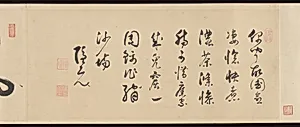
Handscroll of Calligraphy by Ōbaku Zen Monks
mid-17th to mid-18th century
Medium
Forty-three sheets mounted as a pair of handscrolls; ink on paper
Dimensions
a: Image: 11 1/4 in. × 34 ft. 10 1/2 in. (28.5 × 1063 cm) b: Image: 11 1/4 in. × 44 ft. 9 3/8 in. (28.5 × 1365 cm)
Classification
Calligraphy
Culture & Period
Japan · Edo period (1615–1868)
Department
Asian Art
Museum
Metropolitan Museum of Art, New York, NY
Credit
Purchase, Friends of Asian Art Gifts, 2021
Accession Number
2021.185a, b
Rights
Public Domain
Art Historical Context
This exquisite pair of handscrolls calligraphy by Ōbaku Zen monks, led by the influential Chinese monk Yinyuanqi (known in Japan as Ingen Ryū). In the mid-17th century Ingen fled Ming dynasty China amid political turmoil and founded theŌbaku school of Zen Buddhism in Japan during the Edo period (1615–1868). This work, spanning from the mid-17th to mid-18th century, reflects the fusion of Chinese Zen traditions with Japanese culture, as monks inscribed sutras, poems, and Zen sayings across forty-three sheets of ink on paper. Mounted as two monumental handscrolls—one 34 feet 10½ inches long, the other 44 feet 9⅜ inches—these artworks embody the traditional East Asian format designed for sequential viewing, unrolling like a narrative river of brushwork. Calligraphy in Zen practice was more than art; it was a meditative discipline, channeling the monk's spiritual insight through fluid, expressive strokes that vary from bold and vigorous to delicate and introspective. Housed in the Metropolitan Museum of Art's Asian Art Department, these scrolls highlight Ōbaku's role in revitalizing Japanese Zen, blending Chinese orthodoxy with local aesthetics. A testament to cross-cultural exchange, they invite visitors to ponder the harmony of mind, brush, and ink in Edo-era Japan.