
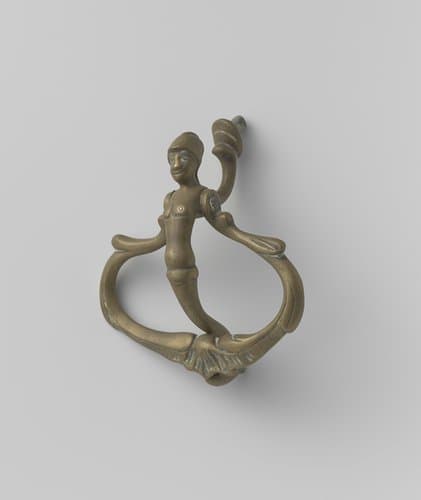
Handvat met hengsel in de vorm van een herm
ca. 1750
Medium
casting
Dimensions
11.3; 7; 13
Rights
Public Domain
About this artwork
width 11.3 cm x height 13 cm x depth 7 cm
Art Historical Context
Step into the elegant world of 18th-century decorative arts with *Handvat met hengsel de vorm van een herm (Handle with Hinge in the Form of Herm), a finely crafted anonymous piece from around 1750. Measuring a compact 11.3 cm wide, 13 cm high, and 7 cm deep, this functional handle transforms everyday utility into classical splendor. Its form draws directly from the ancient herm—a pillar-like sculpture topped with a bust originally used in Greek and Roman times as boundary markers or protective deities, often featuring Hermes, the messenger god. Dated to circa 1750, this object reflects the growing fascination with Greco-Roman antiquity during Europe's Enlightenment era, when artists and craftsmen revived classical motifs amid the transition from Rococo ornamentation to emerging Neoclassicism. Likely intended for a door, cabinet, or vessel, it exemplifies how herms were adapted into rococo and neoclassical furniture hardware, blending reverence for the past with practical innovation. Crafted through casting—a metalworking technique involving molten material poured into molds—this piece highlights skilled anonymous artisanship, probably in a European workshop attuned to antiquarian tastes. Its survival offers a tactile glimpse into how the elite adorned their interiors, merging myth, function, and timeless allure.
About the Artist
anonymous
In the vast tapestry of art history, "Anonymous" stands not as a singular individual but as a collective designation for countless unidentified creators whose works have endured across millennia. These artists, spanning prehistoric cave painters to medieval illuminators and folk craftsmen, produced the foundational layers of human visual culture. Prior to the Renaissance, when individual fame emer...