
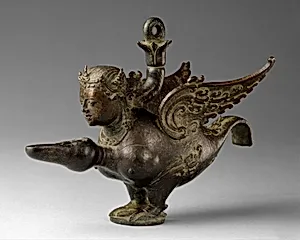
Hanging Lamp in the Form of a Kinnari
Unknown Artist
ca. second half of the 9th–early 10th century
Medium
Bronze
Dimensions
H. 5 3/4 in. (14.6 cm); W. 4 3/8 in. (11.1 cm); L. 7 1/4 in. (18.4 cm)
Classification
Sculpture
Culture & Period
Indonesia (Java) · Central Javanese period
Department
Asian Art
Museum
Metropolitan Museum of Art, New York, NY
Credit
Samuel Eilenberg Collection, Gift of Samuel Eilenberg, 1987
Accession Number
1987.142.24
Rights
Public Domain
Tags
Art Historical Context
This delicate bronze hanging lamp, shaped as a Kinnari—a mythical half-woman, half-bird creature from Hindu-Bdhist folklore—dates to Java's Central Javanese (ca. second half the 9th–early 10th century). just 5¾ inches tall, with a graceful 7¼-inch length, it depicts the Kinnari in a poised, elegant form, her wings poised as if ready for flight. Such functional sculptures blended everyday utility with spiritual symbolism, illuminating temple rituals or elite homes while evoking celestial nymphs known for music, dance, and divine beauty. Crafted in bronze by an unknown Javanese artist, the lamp exemplifies the era's mastery of metal casting, producing finely detailed feathers, jewelry, and expressive features on a small scale. During the Central Javanese period (ca. 732–1000 CE), under dynasties like the Sailendras and Matarams, Java flourished with monumental Hindu-Buddhist temples such as Borobudur and Prambanan, where mythical beings like Kinnaris adorned lintels and reliefs, symbolizing harmony between the human and divine realms. A gem from the Metropolitan Museum of Art's Asian Art collection, gifted by Samuel Eilenberg in 1987, this lamp offers a window into ancient Indonesia's rich fusion of art, mythology, and devotion—reminding us how light once danced with legend in the tropical heart of Southeast Asia.