
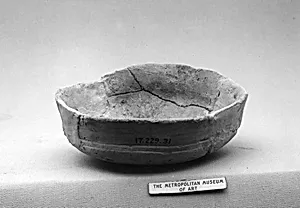
Haniwa Dish
Unknown Artist
4th–7th century
Medium
Earthenware
Dimensions
Diam. 4 3/4 in. (12.1 cm)
Classification
Sculpture
Culture
Japan
Department
Asian Art
Museum
Metropolitan Museum of Art, New York, NY
Credit
Rogers Fund
Accession Number
17.229.31
Rights
Public Domain
Art Historical Context
Nestled in the Metropolitan Museum of Art's Asian Art collection, the *Haniwa Dish* is a delicate earthenware sculpture from 4th–7th Japan, crafted during the Kofun (ca. 250–710 CE). Haniwa, meaning "clay ring" or "circle of clay," were hollow, low-fired clay figures ritually placed around elite burial mounds known as kofun. This modest dish, with a diameter of just 3/4 inches (12.1 cm), exemplifies the stylized, minimalist forms typical of these anonymous works, often depicting everyday objects, animals, or people to honor and protect the deceased in the afterlife. Made from unglazed earthenware, the dish highlights ancient Japanese ceramic techniques: hand-coiled or molded clay fired at low temperatures, resulting in a porous, earthy texture that has endured for over a millennium. Unlike glossy later wares, haniwa's simplicity reflects early Yayoi and Kofun influences, blending functionality with spiritual symbolism—dishes like this might have served as offerings or symbolic vessels in funerary rites. Acquired through the Rogers Fund, this piece offers a window into Japan's prehistoric beliefs in shamanism and ancestor veneration, before the rise of Buddhism. Its small scale belies its cultural weight, connecting visitors to the Yamato clan's mound-building era and the dawn of imperial Japan. A quiet testament to impermanence and reverence, it invites contemplation of lives long past.