
Happiness (from the series A Love)
1887–1903
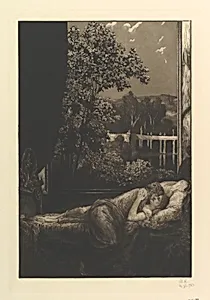
Medium
Etching, engraving, and aquatint; third edition; state seven of seven
Dimensions
Plate: 17 15/16 × 12 3/8 in. (45.6 × 31.5 cm) Sheet: 21 9/16 × 15 7/8 in. (54.7 × 40.4 cm)
Classification
Prints
Department
Drawings and Prints
Museum
Metropolitan Museum of Art, New York, NY
Credit
Gift of Dr. F. H. Hirschland, 1952
Accession Number
52.586.1(5)
Rights
Public Domain
Tags
Art Historical Context
Max Klinger’s "Happiness," created between 1887 and 1903 as part of his print series *A Love*, captures an intimate moment between a man and a woman. Issued in its third edition and seventh state, the work reflects the fin-de-siècle fascination with emotional experience and romantic ideals. Klinger, a leading figure in German Symbolism, often used sequential prints to explore love’s joys and complexities, inviting viewers to reflect on human connection. Executed in etching, engraving, and aquatint, the print demonstrates the rich tonal range and precise linework these techniques afford. The combination allows delicate shading and atmospheric depth, heightening the tender atmosphere suggested by the title and the presence of embracing figures. Such mixed-media approaches were prized in the late nineteenth century for their ability to translate painterly effects into widely distributable editions. Housed today at the Metropolitan Museum of Art, this impression measures just under eighteen by twelve inches in the plate, underscoring Klinger’s mastery of intimate scale. Through its refined technique and evocative subject, the work continues to offer audiences a window into the period’s romantic aspirations.
About the Artist
Wilhelm Felsing|Max Klinger (German| ) · 1857 | –1920 |
German, Leipzig 1857–1920 Großjena|