
Head of a Bearded Man Looking to Lower Left (Nicodemus)
1579–82
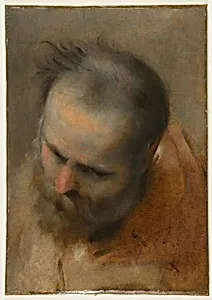
Medium
Brush and oil paint on paper
Dimensions
15 1/4 x 10 3/4in. (38.7 x 27.3cm)
Classification
Drawings
Department
Drawings and Prints
Museum
Metropolitan Museum of Art, New York, NY
Credit
Harry G. Sperling Fund, 1976
Accession Number
1976.87.1
Rights
Public Domain
Tags
Art Historical Context
Federico Barocci, a leading Italian painter from Urbino known for his emotive, lyrical style bridging Mannerism and the emerging Baroque created this intimate study around 157982. Titled *Head of a Bearded Looking to Lower Left (odemus)*, it depicts the biblical figure Nicodemus—famous for his nocturnal visit to Jesus—with a thoughtful gaze downward, capturing profound introspection. Barocci's preparatory drawings like this one were essential to his meticulous process, often refining compositions for major altarpieces during the Counter-Reformation era, when religious art emphasized emotional depth and humanity. Rendered in brush and oil paint on paper—a rare and innovative medium for sketches at the time—this 15¼ × 10¾-inch work showcases Barocci's mastery of sfumato-like blending and luminous highlights. Oil allowed for rich tonal modeling and velvety textures, mimicking the finish of finished paintings while enabling quick, expressive adjustments. Such *bozzetti* (oil sketches) were prized by collectors for their spontaneity and were influential in northern European traditions. Housed in the Metropolitan Museum of Art's Drawings and Prints department, this piece highlights Barocci's focus on male heads as studies in character and light, inviting visitors to appreciate the tender humanity behind grand religious narratives. A gem for fans of Renaissance draftsmanship!
About the Artist
Federico Barocci · 1535–1612
Federico Barocci (c. 1535–1612) was an Italian painter from Urbino whose luminous, emotionally tender religious paintings made him one of the most original and influential artists of the late sixteenth century, bridging Mannerism and the early Baroque. Born in Urbino, the city of Raphael, he studied under Battista Franco and traveled to Rome, where he absorbed the lessons of Raphael, Correggio, an...