
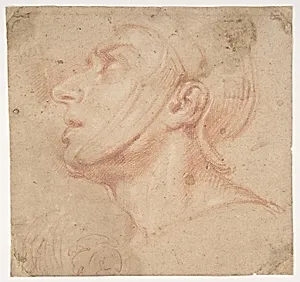
Head of a Man Wearing a Helmet, Looking to Upper Left (recto); Two Sketches, Arms and Hands (verso)
1623–90
Medium
Red chalk, highlighted with a little white (recto); black chalk studies of arms (verso)
Dimensions
6 15/16 x 7 5/16in. (17.7 x 18.5cm)
Classification
Drawings
Department
Drawings and Prints
Museum
Metropolitan Museum of Art, New York, NY
Credit
Gift of Henry Walters, 1917
Accession Number
17.236.30
Rights
Public Domain
Tags
Art Historical Context
This intimate drawing by Francesco di Maria, a17th-century Italian artist active during the vibrant Baroque era (1623–90), captures the recto side with a striking profile view of a man's head turned upward to the left, clad in a helmet. Rendered in red chalk with subtle white highlights, the work exemplifies the preparatory sketches favored by artists of the period for studying light, form, and expression before committing to larger paintings or sculptures. The helmet adds a sense of classical antiquity or martial vigor, evoking Renaissance ideals of heroism filtered through Baroque dynamism. On the verso, di Maria turned the sheet over for quick black chalk studies of arms and hands, showcasing his fluid command of anatomy and gesture. Red chalk was prized for its warm, naturalistic tones ideal for flesh and drapery, while the white heightening creates dramatic chiaroscuro effects reminiscent of Caravaggesque influences in Naples, where di Maria worked. At just under 7 inches square, this double-sided gem reveals the artist's iterative process—practical yet poetic. A gift to the Metropolitan Museum of Art from Henry Walters in 1917, it highlights the enduring value of such studies in drawings collections, offering visitors a window into the creative minds behind grand masterpieces.
About the Artist
Francesco di Maria · 1623–1690
Francesco di Maria (1623–1690) was an Italian Baroque painter active mainly in Naples, where he played a significant role in transmitting the classical tradition of Domenichino to a new generation of Neapolitan artists. Born in Naples, he studied under Domenichino during the master's final decade in the city (1630–1641), absorbing the Roman classicist approach that would distinguish his work from ...