
Head of a Peasant (Tête de paysan)
1894–1905, after a model of 1894
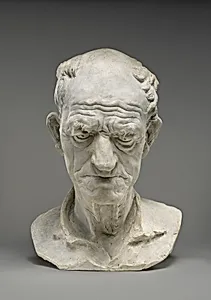
Medium
Plaster
Dimensions
13 3/8 × 9 7/16 × 9 1/2 in. (34 × 24 × 24.1 cm)
Classification
Sculpture
Culture
French
Department
European Sculpture and Decorative Arts
Museum
Metropolitan Museum of Art, New York, NY
Credit
Purchase, Larry and Ann Burns Gift, in honor of Austin B. Chinn, 2023
Accession Number
2023.138
Rights
Public Domain
Tags
Art Historical Context
Aimé-Jules Dalou, a leading French sculptor of the late nineteenth century, created this sensitive plaster head as part of his ongoing exploration of rural life. Working during the Third Republic, Dalou often turned his attention to peasants and laborers, treating them with the same dignity usually reserved for historical or allegorical figures. The work, modeled in 1894 and cast in plaster over the following decade, captures the weathered features and quiet strength of an anonymous countryman. Executed in plaster, the medium allowed Dalou to model fine surface textures—creases around the eyes, the roughened brow, and tousled hair—with direct, tactile immediacy. Such studies frequently served as preparatory works for larger monuments or bronze editions, yet they stand on their own as intimate portraits. By focusing on a single head rather than a full figure, Dalou invites viewers to consider the individuality and humanity of those who worked the land. Acquired by the Metropolitan Museum in 2023, *Head of a Peasant* offers a window into Dalou’s commitment to realism and social observation. The sculpture’s modest scale and unidealized features remind us that, for this artist, the face of rural France carried its own quiet nobility.