
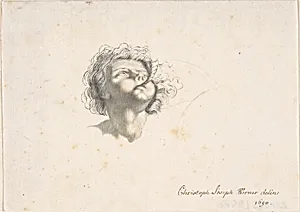
Head of a Putto
Medium
Brush and brown ink
Dimensions
sheet: 3 1/8 x 4 5/16 in. (8 x 11 cm)
Classification
Drawings
Department
Drawings and Prints
Museum
Metropolitan Museum of Art, New York, NY
Credit
Purchase, François van den Broek d'Obrenan Gift, 2007
Accession Number
2007.420.2
Rights
Public Domain
Tags
Art Historical Context
In the late Baroque era, Christoph Joseph Werner, an Austrian sculptor and draftsman active in Vienna, captured the playful essence of childhood in his delicate drawing *Head of a Putto* from 1690. This sheet, executed in brush and brown ink on modest 3 1/8 x 4 5/16 inches, exemplifies the preparatory sketches artists used for larger sculptures or frescoes. Putti—chubby, winged cherubs symbolizing innocence, love, divine joy—were staples of Baroque decoration, adorning churches, palaces, and gardens across Europe to evoke exuberance and movement. Werner's fluid brushwork brings the putto's rounded cheeks, tousled curls, and mischievous gaze to life with remarkable tenderness and immediacy. The brown ink's warm tones and subtle modeling highlight his mastery of light and shadow, techniques honed in the dynamic style of the period's masters like Bernini. Likely a study for a sculptural detail, this work reveals the meticulous planning behind Baroque opulence. Acquired by the Metropolitan Museum of Art in 2007 through the François van den Broek d'Obrenan Gift, *Head of a Putto* invites visitors to appreciate the artistry of the sketch itself—a window into 17th-century creativity where whimsy met profound skill.
About the Artist
Christoph Joseph Werner · 1670–1750
German, ca. 1670–1750 Dresden