
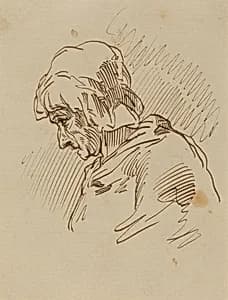
Head of a Woman
1801 to 1825
Medium
pen and brown ink on laid paper
Dimensions
overall (approximate): 13.5 x 11.5 cm (5 5/16 x 4 1/2 in.)
Classification
Drawing
Department
CG-E
Museum
National Gallery of Art, Washington, D.C.
Credit
Rosenwald Collection
Accession Number
1943.3.4600
Rights
Public Domain
Art Historical Context
Nestled in the National Gallery of Art's Rosen Collection, *Head of a Woman* is a delicate drawing by French artist Paul Gavarni (1804–1866), between 1801 and 1825. Rendered in pen and brown ink on laid—a traditional handmade support with visible chain lines—this intimate study measures just 13.5 x 11.5 cm, close contemplation. Gavarni's early work captures the subtle nuances of a woman's face, showcasing his emerging mastery of line as a tool for expression. Gavarni, renowned for his lively illustrations of Parisian society and fashion in later decades, honed his skills through such precise drawings. The brown ink lends a warm, earthy tone, while the pen's fluid strokes suggest movement and character, hallmarks of his caricatural yet empathetic style. This piece reflects the Romantic-era fascination with individual portraiture amid France's post-Revolutionary cultural shifts, where artists like Gavarni bridged fine art and popular printmaking. As a classified drawing from the CG-E department, it exemplifies the technical virtuosity of 19th-century draftsmen, offering visitors a glimpse into Gavarni's formative years before his fame in journals like *Le Charivari*. A quiet gem, it reminds us how small sketches can reveal profound humanity.
About the Artist
Paul Gavarni · 1804–1866
Paul Gavarni, born Sulpice Guillaume Chevalier on January 13, 1804, in Paris to a cooper father from Burgundy and mother Marie-Monique Thiémet—whose brother, painter Guillaume Thiémet, served as his godfather—began his career far from the art world. As a youth, he worked in a machine factory and studied mechanical drawing at the Conservatoire des Arts et Métiers in 1818, followed by evening classe...