
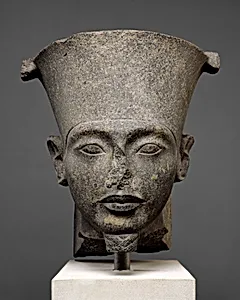
Head of the god Amun
Unknown Artist
ca. 1336–1327 B.C.
Medium
Granodiorite
Dimensions
H. 44 cm (17 5/16 in.), W. 38.2 (15 1/16 in.); D. 41.5 (16 5/16 in.)
Classification
Head, Amun, Tutankhamun
Period
New Kingdom, post-Amarna Period
Department
Egyptian Art
Museum
Metropolitan Museum of Art, New York, NY
Credit
Rogers Fund, 1907
Accession Number
07.228.34
Rights
Public Domain
Tags
Art Historical Context
Behold the majestic *Head of the God Amun*, a striking granodiorite sculpture from's New Kingdom, dating around 1336–1327 B.C. Crafted during Dynasty 18's post-Amarna Period, fragment—measuring 44 cm high—likely once crowned a larger statue of Amun, the supreme deity and king of the gods. Carved from tough granodiorite, a igneous stone quarried from Aswan, it exemplifies the era's mastery of hard-stone sculpture, where artisans used copper tools and abrasives to achieve smooth, polished surfaces that evoke eternal divinity. This piece emerges from a pivotal moment: the aftermath of Akhenaten's radical Amarna revolution, which briefly sidelined Amun in favor of the sun god Aten. With Tutankhamun's reign, traditional worship roared back, restoring Amun's prominence in Thebes. The idealized features—serene yet commanding—reflect canonized Egyptian proportions, symbolizing the god's cosmic power and pharaohs' divine legitimacy. Such sculptures adorned temples, channeling Amun's protective aura. Today, acquired via the Rogers Fund in 1907, it graces the Metropolitan Museum of Art's Egyptian Art galleries. Gaze into those almond-shaped eyes, and feel the ancient pulse of faith in stone.