
Head of Tiberius
n.d.
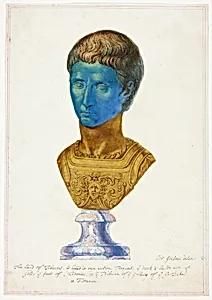
Medium
Gouache, heightened with gold paint, over black chalk, on ivory laid paper
Dimensions
27.8 × 19.5 cm (11 × 7 11/16 in.)
Classification
watercolor
Department
Prints and Drawings
Museum
Art Institute of Chicago
Accession Number
115518
Rights
Public Domain
Art Historical Context
Nestled in the Art Institute of Chicago's Prints and Drawings collection, *Head of Tiberius* by Giuseppe Grisoni (c. 1693–1769) captures the stern visage of the Roman emperor Tiberius (r. 14–37 CE) in a delicate miniature format. Grisoni, a Flemish-Italian Baroque painter known for his work in Rome and London, often drew from classical antiquity, blending historical reverence with rococo elegance. This undated piece exemplifies his skill in portraiture, evoking the emperor's legendary intensity amid Rome's imperial legacy of power and intrigue. Executed in gouache heightened with shimmering gold paint over black chalk on luxurious ivory laid paper (27.8 × 19.5 cm), the work showcases virtuoso techniques of the 18th century. Gouache's opaque body allowed for rich, velvety tones, while gold accents lent a regal, almost jewel-like luminescence—ideal for intimate collector's items or cabinet pieces. Classified as a watercolor, it highlights the era's fascination with portable, luminous drawings that mimicked oil paintings or precious enamels. This artwork reflects the Enlightenment's passion for ancient Rome, serving as both artistic study and cultural talisman. Visitors can appreciate how Grisoni's masterful layering brings Tiberius to life, bridging 2,000 years of history in a single, radiant gaze.
About the Artist
Giuseppe Grisoni · 1699–1769
Giuseppe Grisoni was born in Mons, in the Spanish Netherlands, in 1699, to an Italian family, and his career unfolded across multiple European courts and cultural centers, making him a quintessentially cosmopolitan figure of the early eighteenth century. He received his artistic training in Florence, where he absorbed the rich tradition of Florentine portraiture and absorbed the influence of the G...