
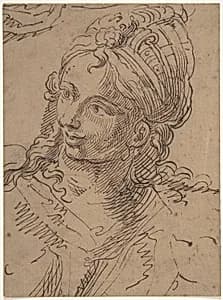
Head of Woman
17th century
Medium
Pen and brown ink on tan paper with one trace of red chalk
Dimensions
5-5/8 x 4-3/16 in. (14.3 x 10.6 cm)
Classification
Drawings
Department
Drawings and Prints
Museum
Metropolitan Museum of Art, New York, NY
Credit
Gift of Harry G. Friedman, 1960
Accession Number
60.66.20
Rights
Public Domain
Tags
Art Historical Context
This delicate *Head of Woman*, created by an anonymous Italian artist in the 17 century, exemplifies the intimate preparatory sketches common during the Baroque era. Executed in pen and brown ink on paper, with a single subtle trace of red chalk, small drawing measures just 5-5/8 x 4-3/16 inches (14.3 x 10.6 cm). Such modest dimensions suggest it originated from an artist's sketchbook, likely used to study facial features and expressions before larger compositions. In 17th-century Italy, drawings like this were essential tools for artists honing their craft amid the dramatic naturalism of the Baroque movement. The precise lines of brown ink model the woman's face with remarkable sensitivity, capturing contours and subtle modeling, while the faint red chalk hints at early explorations of flesh tones. These techniques reflect a period when anatomical accuracy and emotional depth were prized, influencing masters from Caravaggio to Bernini. Today, this gem resides in the Metropolitan Museum of Art's Department of Drawings and Prints, a generous gift from Harry G. Friedman in 1960. It invites us to ponder the anonymous hand behind its creation, reminding visitors of the unsung studies that birthed grand masterpieces. Pause and admire the timeless gaze of this enigmatic woman.