
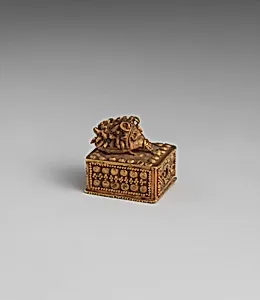
Hedgehog on box pendant
Unknown Artist
4th century –30 B.C., perhaps
Medium
Gold
Dimensions
L. 4.9 × W. 1.1 cm (1 15/16 × 7/16 in.)
Classification
Pendant, hedgehog on box
Period
Late Period–Ptolemaic Period
Department
Egyptian Art
Museum
Metropolitan Museum of Art, New York, NY
Credit
Gift of Helen Miller Gould, 1910
Accession Number
10.130.1516
Rights
Public Domain
Tags
Art Historical Context
This delicate gold pendant, titled *Hedgehog on Box*, hails from ancient Egypt's Late Period to Ptolemaic era (circa 4th century B.C. to 30 B.C.), a time when native pharaonic traditions blended with emerging Hellenistic influences under Ptolemaic rule. Measuring just 4.9 cm long and 1.1 cm wide, this tiny jewel—likely worn as an amulet or necklace ornament—showcases the exquisite metalworking skills of unknown artisans. Crafted from pure gold, a precious metal symbolizing eternity and the divine in Egyptian culture, it depicts a hedgehog perched atop a box-like base, evoking the natural world in miniature form. Animal motifs like the hedgehog were common in Egyptian jewelry, often carrying protective or symbolic meanings tied to fertility, rebirth, or warding off evil—qualities befitting a personal talisman. The hedgehog's spiky form and compact design highlight the period's mastery of granulation and repoussé techniques, where gold was hammered, chased, and adorned with fine details to create lifelike textures. Such pendants were treasured by elites, suspended from chains for daily wear or ritual use. Today, this rare artifact graces the Metropolitan Museum of Art's Egyptian Art collection, a gift from Helen Miller Gould in 1910. It offers a glimpse into the everyday mysticism of ancient Egyptians, where even a humble creature became a golden guardian.