
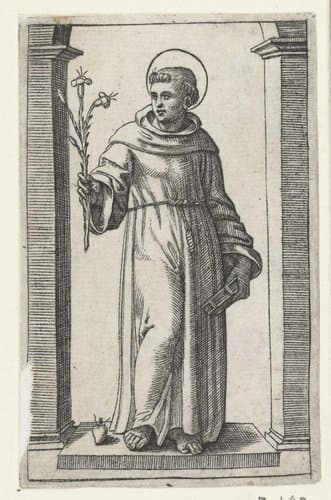
Heilige Antonius van Padua met lelie en hart
1500 - 1527
Medium
engraving
Dimensions
82; 52
Rights
Public Domain
About this artwork
collector's mark: Lugt 12
Art Historical Context
**Heilige Antonius vanua met lelie en hart** *Marcantonio Raimondi,. 1500–1527, Engraving, 82 × 52 mm* This intimate engraving by Marcantonio Raimondi captures Saint Anthony of Padua a beloved 13th-century Franciscan friar revered for his eloquence and miracles. Depicted with a lily—symbolizing purity—and a heart, evoking his legendary devotion or the miracle of a beating heart proving faith, the image reflects Renaissance devotion to popular saints. Raimondi, a pioneering Italian engraver active in Rome during the High Renaissance, masterfully rendered these attributes with fine lines, making sacred imagery portable and personal for the faithful. As one of the era's greatest reproductive printmakers, Raimondi elevated engraving from mere craft to high art, often collaborating with masters like Raphael to disseminate their designs widely. This technique allowed detailed, tonal depth on a tiny scale, ideal for collectors and pilgrims. The print's small dimensions highlight its role in private devotion or scholarly cabinets, bridging elite workshops with everyday spirituality. Bearing the collector's mark Lugt 12, this piece boasts notable provenance, underscoring its enduring value among connoisseurs. A testament to early 16th-century print culture, it invites us to appreciate how engravings democratized Renaissance beauty. (198 words)
About the Artist
Marcantonio Raimondi · 1475–1534
Marcantonio Raimondi (c. 1480–1534), born near Bologna, Italy, emerged as one of the Renaissance's premier engravers, revolutionizing printmaking through his mastery of reproductive techniques. He trained in the workshop of the goldsmith, painter, and niellist Francesco Francia, whose influence is evident in his early engravings, such as the goldsmith-like shading in *Pyramus and Thisbe* (1505), h...