
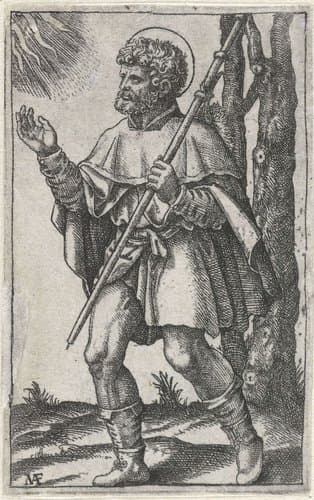
Heilige Rochus als pelgrim met pelgrimsstaf en pestbult op been
1500 - 1527
Medium
engraving
Dimensions
53; 83
Rights
Public Domain
About this artwork
gravure
Art Historical Context
In the early 16th century, Italian engraver Marcantonio Raimondi captured the devotion to Saint Roch, the patron saint of plague victims, in this intimate engraving titled *Heilige Rochus als pelgrim met pelgrimsstaf en pestbult op been* (Saint Roch as Pilgrim with Pilgrim's Staff and Plague Boil on Leg). Created between 1500 and 1527, the work measures just 83mm by 53mm, making it a pocket-sized devotional image ideal for personal prayer during Europe's recurring plague outbreaks. Roch is depicted as a weary pilgrim, staff in hand and a telltale plague bubo on his leg, embodying resilience and intercession amid widespread fear of the Black Death's lingering threat. Raimondi's mastery of engraving—a technique he elevated to rival painting—allowed precise lines and rich tonal contrasts on copper plates, enabling mass production of high-fidelity religious art. A pioneer in reproductive printmaking, he often drew from Renaissance masters like Raphael, democratizing sacred imagery for pilgrims and the faithful beyond elite patrons. This small gravure (engraving) reflects the era's blend of piety and artistry, offering solace in a time when plagues ravaged communities and saints like Roch were desperately invoked for protection. Today, it reminds us of art's role in coping with crisis, its fine details inviting close contemplation in museum vitrines.
About the Artist
Marcantonio Raimondi · 1475–1534
Marcantonio Raimondi (c. 1480–1534), born near Bologna, Italy, emerged as one of the Renaissance's premier engravers, revolutionizing printmaking through his mastery of reproductive techniques. He trained in the workshop of the goldsmith, painter, and niellist Francesco Francia, whose influence is evident in his early engravings, such as the goldsmith-like shading in *Pyramus and Thisbe* (1505), h...