
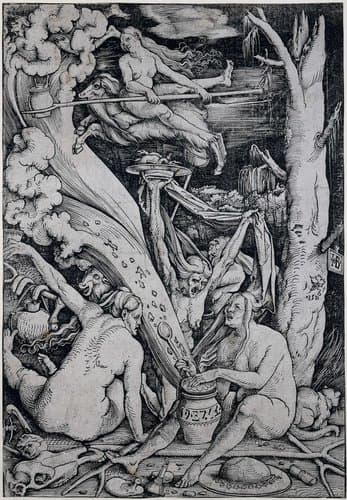
Heksen toveren tijdens heksensabbat
Medium
paper
Dimensions
378; 257
Rights
Public Domain
About this artwork
height 378 mm x width 257 mm
Art Historical Context
Hans Baldung Grien's *Heksen toveren tijdens heksensabbat* (Witches Conjuring During the Witches' Sabbath), created in 1510, the artist's fascination with the supernatural during the Northern Renaissance. A gifted pupil of Albrecht Dürer, Baldung (1484/85–1545) was renowned for his innovative woodcuts and drawings on paper, often exploring themes of witchcraft, eroticism, and mortality. This intimate work, measuring 378 mm high by 257 mm wide, exemplifies his mastery of line and shadow on paper, likely a detailed drawing that evokes the eerie rituals of a witches' gathering. In early 16th-century Europe, amid rising fears of witchcraft and the eve of widespread witch hunts, Baldung's depictions stood out for their vivid, almost sensual portrayal of female witches engaged in spell-casting and sabbath revelry. His style blends Gothic expressiveness with Renaissance precision, using intricate hatching and chiaroscuro effects to heighten drama and psychological tension. This piece reflects the cultural zeitgeist, where folklore and religious fervor intertwined, making witchcraft imagery both cautionary and captivating. As a curator's highlight, this artwork invites visitors to ponder the blend of fear and allure in Renaissance imagination, showcasing Baldung's enduring influence on printmaking and the macabre in art.
About the Artist
Hans Baldung Grien
Hans Baldung, known by the nickname Grien, was born around 1484 or 1485 in Schwäbisch Gmünd, in the Swabia region of what is now Germany. He came from a distinguished academic family — his father Johann Baldung was a university-educated jurist who served as legal adviser to the bishop of Strasbourg — making Hans a notable exception as the first male in his family not to attend university, and one ...