
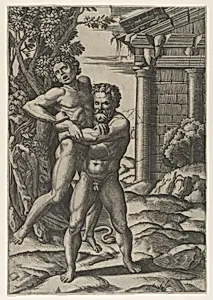
Hercules holding Antaeus by the waist and lifting him off his feet
Medium
Engraving
Dimensions
12 1/16 x 8 3/8 in. (30.6 x 21.2 cm)
Classification
Prints
Department
Drawings and Prints
Museum
Metropolitan Museum of Art, New York, NY
Credit
The Elisha Whittelsey Collection, The Elisha Whittelsey Fund, 1949
Accession Number
49.97.121
Rights
Public Domain
Tags
Art Historical Context
Behold the dramatic tension in *Hercules Holding Antaeus by the Waist and Lifting Him off His Feet*, a masterful engraving from around 1520–22. This print depicts a pivotal moment from Greek mythology: the hero Hercules defeats the earth-born giant Antaeus—whose strength derived from touching the ground—by hoisting him aloft, severing his vital link to Gaia. Designed by the Renaissance Raphael (Raffaello Sanzio) collaboration with his pupil Giulio Romano, it was expertly executed by engraver Marcantonio Raimondi, showcasing the era's innovative artist-engraver partnerships. Engraving, an intaglio technique where intricate lines are incised into a copper plate and inked under pressure, allowed for unprecedented detail and tonal depth in this 12⅛ × 8⅜-inch sheet. Raimondi's precise burin work captures muscular strain, twisting forms, and dynamic foreshortening, hallmarks of High Renaissance anatomy and movement influenced by classical antiquity. These prints revolutionized art dissemination, making Raphael's compositions accessible beyond elite patrons. Housed in the Metropolitan Museum of Art's Drawings and Prints department (Elisha Whittelsey Collection, 1949), this work exemplifies how Raphael's workshop bridged painting and printmaking, influencing generations and democratizing Renaissance ideals of heroism and humanism. A thrilling glimpse into mythic power rendered eternal through ink and paper!
About the Artist
Marcantonio Raimondi|Giulio Romano|Raphael (Raffaello Sanzio or Santi) · 1475–1534
Marcantonio Raimondi (c. 1480–1534), born near Bologna, Italy, emerged as one of the Renaissance's premier engravers, revolutionizing printmaking through his mastery of reproductive techniques. He trained in the workshop of the goldsmith, painter, and niellist Francesco Francia, whose influence is evident in his early engravings, such as the goldsmith-like shading in *Pyramus and Thisbe* (1505), h...