
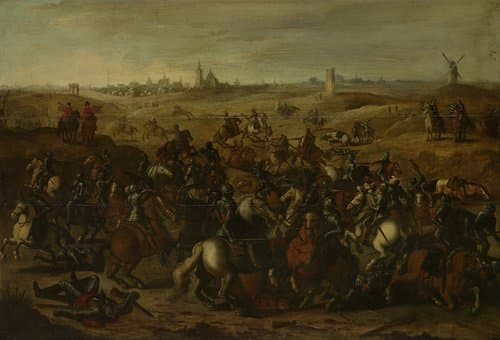
Het gevecht tussen Gerard Abrahamsz Houwelingen en Pierre de Bréauté op de Vughterheide, 5 februari 1600
c. 1635
Medium
oil on panel
Dimensions
72; 91.7; 126; 106; 9.6
Rights
Public Domain
About this artwork
…; ? a French or Netherlandish collection;{On a label on the reverse is an inscription in French attributing the painting to Palamedes; this is the only inconclusive evidence of a French or Netherlandish provenance.}…; sale, Jan Hendrik Cremer (1813-85, Brussels), Amsterdam (F. Muller _et al._), 21 June 1887, no. 40, as Sebastiaan Vrancx, fl. 95, to ‘het Ministerie’ for the museum;{Copy RKD. NHA, ARS, IS, inv. 167, no. 196 (28 June 1887; no. 1336 KW); NHA, ARS, Kop, no. 289, pp. 148-49, no. 329 ...
Art Historical Context
Sebastiaen Vrancx’s dynamic oil-on-panel painting captures a dramatic skirmish that took place on the Vughterheide heath near ’s-Hertogenbosch on 5 February 1600. The scene shows the confrontation between the Dutch officer Gerard Abrahamsz Houwelingen and the French-born commander Pierre de Bréauté, an episode rooted in the closing stages of the Eighty Years’ War. Painted around 1635, roughly three decades after the event, the work reflects the continuing fascination with recent military history in the newly independent Dutch Republic. Vrancx, a leading Flemish specialist in battle scenes, excelled at lively compositions filled with rearing horses, clashing cavalry, and clouds of dust and smoke. Working in the Baroque tradition, he combined meticulous detail with a sense of movement and urgency, inviting viewers to feel the chaos and courage of the battlefield. The relatively modest scale (72 × 106 cm) allows the painting’s intricate figures and landscape to be appreciated at close range. Acquired by the Rijksmuseum in 1887, the panel has spent much of its later life on long-term loan, including periods at Muiderslot. Today it remains a vivid reminder of how seventeenth-century artists transformed contemporary conflicts into enduring images of national memory and artistic skill.