
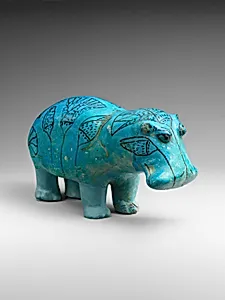
Hippopotamus ("William")
Unknown Artist
ca. 1961–1878 B.C.
Medium
Faience
Dimensions
L. 20 cm (7 7/8 in.); W. 7.5 cm (2 15/16 in.); H. 11.2 cm (4 7/16 in.)
Classification
Figurine, Hippopotamus ("William")
Period
Middle Kingdom
Department
Egyptian Art
Museum
Metropolitan Museum of Art, New York, NY
Credit
Gift of Edward S. Harkness, 1917
Accession Number
17.9.1
Rights
Public Domain
Tags
Art Historical Context
This faience hippopotamus, affectionately known as "William," was created during Egypt’s Middle Kingdom, Dynasty 12 (ca. 1961–1878 B.C.). Standing just 11.2 cm tall and 20 cm long, the small sculpture reflects the period’s renewed emphasis on fine craftsmanship and symbolic objects for both daily life and the afterlife. Faience, a glazed quartz-based ceramic, allowed artisans to achieve a brilliant turquoise color that evoked the life-giving waters of the Nile, making it a favored medium for animal figures. Hippopotamuses carried rich cultural meanings in ancient Egypt, representing both the fertile power of the river and protective forces. Such figurines were often placed in tombs, where they served as amulets or companions for the deceased. The unknown artist’s careful modeling of the animal’s sturdy form and alert posture demonstrates the Middle Kingdom’s skill in capturing naturalistic details within a compact, durable material. Acquired by the Metropolitan Museum of Art in 1917 as a gift, this piece remains one of the most beloved examples of Egyptian art, offering visitors a vivid glimpse into the beliefs and artistic traditions of a golden age more than 3,800 years ago.