
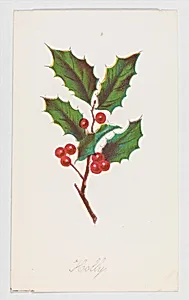
Holly from Autumn Leaves Part 2
Medium
Color lithograph
Dimensions
Sheet: 4 1/8 x 2 7/16 in. (10.4 x 6.2 cm)
Classification
Prints|Ephemera
Department
Drawings and Prints
Museum
Metropolitan Museum of Art, New York, NY
Credit
The Jefferson R. Burdick Collection, Gift of Jefferson R. Burdick, 1948
Accession Number
48.61(86)
Rights
Public Domain
Tags
Art Historical Context
Step into the vibrant world of 19th-century American printmaking with *Holly from Autumn Leaves Part2*, a delicate color lithograph produced by Louis Prang &. in 1862. Measuring just 4 1/8 x 2 7/16 inches, this petite gem captures the lush red berries and glossy green leaves of holly with astonishing realism. Louis Prang, a Boston-based innovator often called the "father of the American Christmas card," pioneeredolithography—a technique that layered colored inks through multiple lithographic stones to mimic hand-painted watercolors at affordable prices. Created during the Civil War era, this print belongs to Prang's popular *Autumn Leaves* series, which celebrated nature's fleeting beauty through meticulously detailed botanical studies. Chromolithography revolutionized art access, allowing middle-class households to adorn scrapbooks, albums, or holiday decorations with these ephemera treasures. The holly motif evokes autumn abundance and hints at winter festivities, blending scientific precision with romantic nostalgia. Today, housed in The Metropolitan Museum of Art's Jefferson R. Burdick Collection—a landmark gift of 30,000 prints—this work highlights how Prang's firm made high-quality nature art ubiquitous, bridging art, science, and domestic life in Victorian America. A tiny portal to a colorful past!
About the Artist
Louis Prang & Co. · 1800–1950
Louis Prang & Co. was the Boston printing firm that introduced the Christmas card to the American public and elevated chromolithography to the level of a serious art form. Its founder, Louis Prang (1824–1909), was born in Breslau, Prussia (now Wrocław, Poland), where he trained as a cloth printer and dyer. After participating in revolutionary activity against the Prussian government, he fled first...