
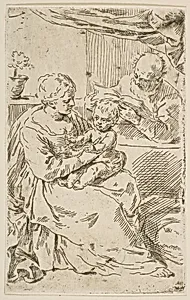
Holy Family with a Rosary, copy after Cantarini
ca. 1640–42 or after
Medium
Etching
Dimensions
Sheet (Trimmed): 5 1/16 × 3 5/16 in. (12.9 × 8.4 cm)
Classification
Prints
Department
Drawings and Prints
Museum
Metropolitan Museum of Art, New York, NY
Credit
Harris Brisbane Dick Fund, 1926
Accession Number
26.70.4(172)
Rights
Public Domain
Tags
Art Historical Context
This delicate etching, *Holy Family with a Ros*, is a copy after the 17th-century Italian artist Cantarini (16121648), dated around 1640–42 or later. Cantarini, a Bolognese master influenced by the elegant classicism of Guido Reni specialized in religious subjects during the Baroque era. Here, the intimate depiction of the Virgin Mary, the Christ Child, and likely Saint Joseph gathered with a rosary evokes devotion, a common motif in Catholic art amid the Counter-Reformation's push for popular piety. Etching, the printmaking technique used, involves coating a copper plate with acid-resistant ground, scratching lines through it, and immersing in acid to etch the grooves. In Cantarini's hands—or his copyist's—this allowed precise, fluid lines ideal for small-scale works like this trimmed sheet (5 1/16 × 3 5/16 in.), making sacred imagery affordable and widespread. Distributed through printshops, such pieces brought the Holy Family's spiritual warmth into homes, reinforcing rosary prayer as a meditative practice. Acquired via the Harris Brisbane Dick Fund in 1926, this print from The Metropolitan Museum of Art's Drawings and Prints collection highlights how reproductive prints preserved and popularized Baroque devotional art, bridging elite painting with everyday faith.
About the Artist
Simone Cantarini · 1612–1648
He was one of the most eminent pupils of Guido Reni and one of the most gifted engravers in the tradition of the Carracci. He had a strong personality and developed a highly original style, which united aspects of Bolognese classicism with a bold naturalism. Comment on works: Religious