
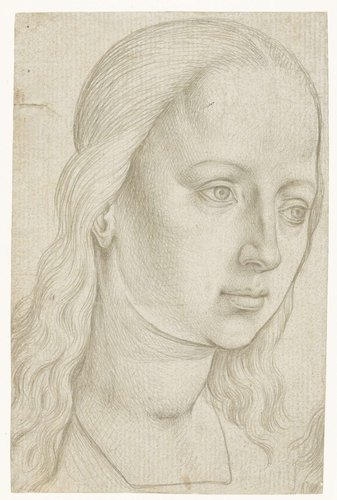
Hoofd van een vrouwelijke heilige of van Maria
1440 - 1478
Medium
prepared paper
Dimensions
97; 148
Rights
Public Domain
About this artwork
hoogte 148 mm x breedte 97 mm
Art Historical Context
Behold the delicate "Hoofd van een vrouwelijkeige of van Maria"Head of a Female Saint of Mary), a poignant drawing by Hugo van der Goes one of the foremost Flemish masters of the Northern Renaissance (c. 0–1478). Created during the vibrant 15th century in the Low Countries, this small-scale work on prepared paper—measuring just 148 mm high by 97 mm wide—captures the serene visage of a holy woman, likely the Virgin Mary or a revered saint. Van der Goes, known for his groundbreaking oil paintings like the Portinari Altarpiece, here showcases his mastery in preparatory sketches, bridging the gap between medieval piety and emerging realism. The use of prepared paper, a technique popular among Netherlandish artists, allowed for subtle tonal modeling with chalk or charcoal, lending the face a lifelike glow and introspective depth. This intimate study reflects the era's devotional fervor, where such images served as aids for meditation or models for larger altarpieces, emphasizing spiritual grace amid the detailed observation of human features that defined Early Netherlandish art. As a rare surviving drawing from van der Goes' hand, it offers a window into his workshop practices and the cultural reverence for Marian iconography in late medieval Europe, inviting visitors to ponder the quiet power of portraiture in faith and art.